The Perfect 2 Day Hampi Itinerary: Practical Guide to Temples, Ruins and Majestic Landscapes
Hampi is one of those places that stays with you long after you leave. Not because it is loud or overwhelming, but because it quietly gets under your skin. Giant boulders balanced in impossible ways, ancient temples rising out of open landscapes, and dusty village roads that suddenly turn into UNESCO-listed ruins. It feels less like visiting an ancient site and more like living inside a place frozen in time.
Located in Karnataka, in southern India, Hampi was one of our favourite destinations across all of our India trips, and somewhere we already know we will return to. It is not the easiest place to reach, but that sense of remoteness is part of the magic. The moment you arrive, it feels as though the modern world has stepped back and history has taken over.
This 2-day Hampi itinerary is based exactly on how we explored the area, moving at a comfortable pace and focusing on what felt most special rather than trying to see everything. We travelled around by auto-rickshaw, stayed near the ruins, and spent our days wandering temples, chilling in ‘hippie cafes’, and watching the sun set over the landscape.
If you are planning a short trip, this Hampi itinerary for 2 days is designed to help you decide where to stay, how to get around, where to eat, and what to prioritise without turning your visit into a rushed checklist. Hampi rewards slow travel, and two well-planned days are enough to experience why it is one of India’s most unforgettable places.
Why Hampi is Worth Visiting
Hampi is not a place you visit for one single attraction. You come for the overall experience. It suits travellers who enjoy wandering without a strict plan, who are curious about history, and who appreciate places that still feel raw, open, and slightly untamed.
What makes Hampi so special is its sheer scale. The ruins are spread across a vast landscape rather than fenced off or compressed into a single archaeological site. You might find an ancient temple standing beside banana plantations, royal enclosures set next to quiet village homes, or sacred hills overlooking the Tungabhadra River, where locals still bathe and pray each day. The past and present exist side by side, without clear boundaries.
What really stood out to us was the variety. Hampi manages to be many different things at once, depending on what kind of traveller you are.
If you’re drawn to dramatic landscapes, you’ll love Hampi’s surreal rocky terrain, with giant boulders piled up in ways that look almost impossible. If the spiritual side of India interests you, Hampi is home to some of the region’s most important and still-functioning temples, where chanting, rituals, and daily worship continue as they have for centuries. History lovers will appreciate exploring the ruins of Vijayanagara, once one of the largest and wealthiest empires in the world. And if you’re simply looking to slow down, relax, and experience a quieter side of India, Hampi still has a lingering hippie atmosphere that feels refreshingly unpolished.
It is this mix of culture, nature, history, and everyday life that makes Hampi feel less like a tourist attraction and more like a place you genuinely experience.
Where to Stay in Hampi
Choosing where to stay in Hampi can have a big impact on your overall experience, especially if you only have a couple of days. The area is spread out, transport takes time, and the heat can be intense, so having a comfortable and well-located base really matters.
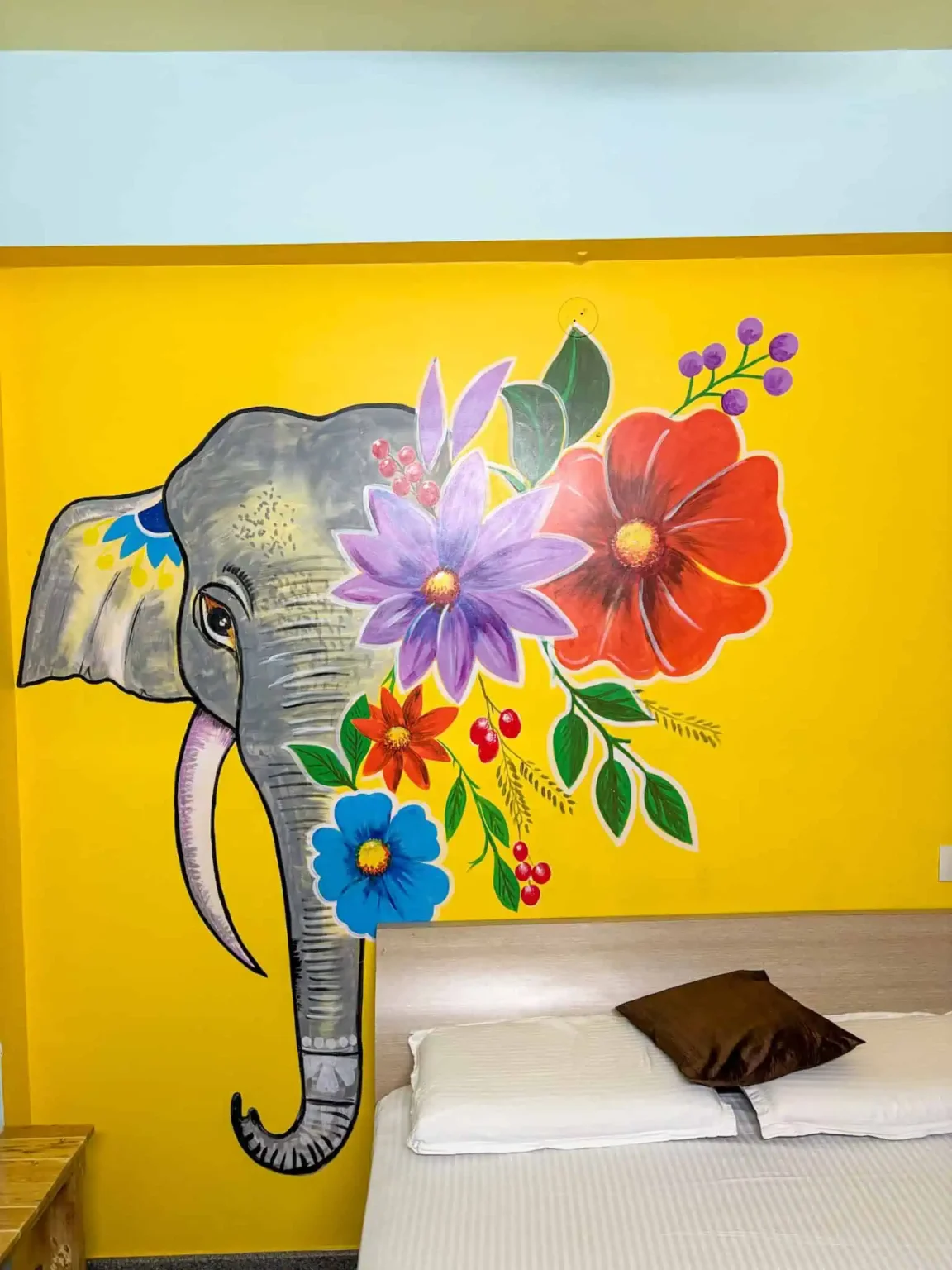
We stayed at Mango Tree Homestay, and it worked perfectly for exploring Hampi over two days. It is calm, comfortable, and set slightly away from the busiest parts of Hampi, which made it feel like a genuine retreat after long days out in the sun.
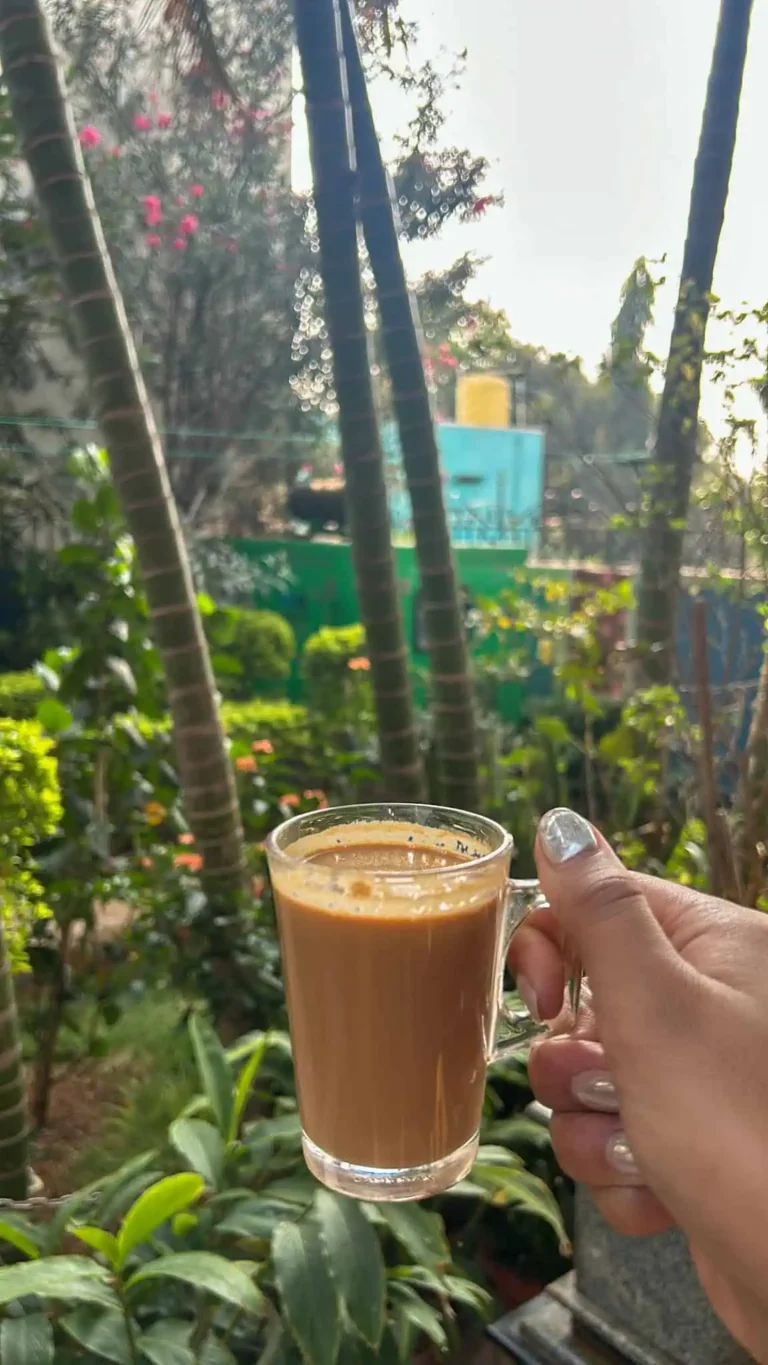
One of our favourite parts of staying here was the garden. Breakfast each morning was served outside, surrounded by greenery and birdsong, which was a lovely and peaceful way to start the day before heading out to the ruins.
The owner, Ms Laxmi, was incredibly helpful throughout our stay. She assisted with organising tuk-tuks, stored our bags on check-out day, and even let us shower and change in a spare room free of charge before our overnight train. Small gestures like this make a big difference when travelling in India, and it made our stay feel genuinely welcoming rather than transactional.
If you are deciding where to stay in Hampi, it helps to understand the three main areas travellers usually choose from.
Best Areas to Stay in Hampi
The Hampi village and Hampi Bazaar area is the most central and atmospheric option. Staying here puts you right among the temples and ruins, and it’s easy to walk around in the early mornings and evenings. However, accommodation in this area is often quite basic, and there have been ongoing legal disputes that have resulted in some guesthouses being suddenly closed or even demolished. Because of this, it can be a slightly unpredictable place to stay.
Across the river near Anegundi, often referred to as Hippie Island, is a much greener and quieter option. This side of the river is ideal if you want a slower, more relaxed Hampi itinerary, with easy cycling routes, rice fields, and fewer crowds. The downside is access. Once the river boats stop running in the evening, getting back to Hampi can be difficult, as the nearest bridge is a long drive away. This can limit flexibility if you want to explore Hampi itself at sunrise or sunset.
The third option is staying in Kamalapur or Hosapet, which are located on the Hampi side of the river but slightly away from the main tourist centre. In our experience, this is one of the best areas to stay in Hampi, especially Kamalapur. These areas tend to be quieter, cleaner, and more comfortable, with easier access to the main ruins and the Hosapet train station. This is where accommodations like Mango Tree Homestay really stand out, offering a good balance between location, comfort, and ease of travel.
If you are visiting Hampi for two days and want a smooth, stress-free experience, staying on the Hampi side of the river in Kamalapur or nearby areas is a very practical choice.
How to Get to Hampi
Hampi is not the easiest place to reach, but that sense of effort is part of what keeps it feeling special. We are so glad we persevered to include Hampi in our South India Itinerary. If you’re planning your Hampi trip, here’s how to get to Hampi by train or road and make the most of your 2-day visit.
Reaching Hampi by Train
See our post on how to book Indian Trains, for tips on how to get the cheapest tickets, pick the right class for you and pay with foreign cards.
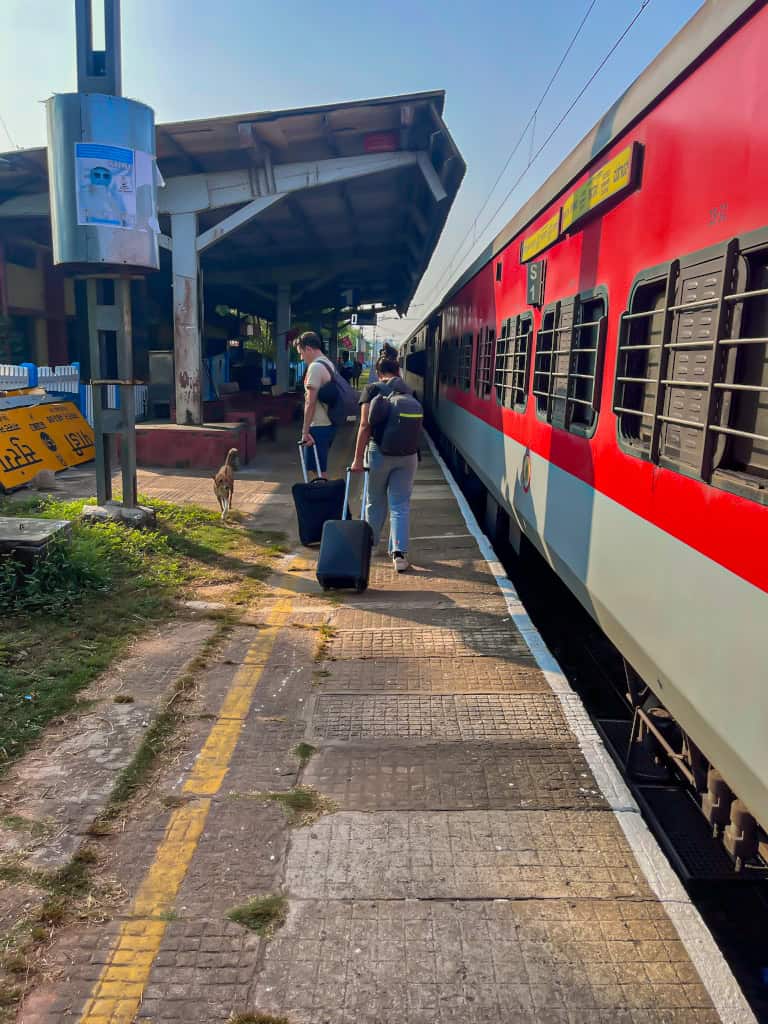
We travelled to Hampi on the Hampi Express overnight train, which arrives at Hospet Junction. Hospet is around 12 kilometres from Hampi, and the journey from the station takes roughly 30 minutes by taxi or auto rickshaw. Arriving in the early morning, with cooler air and soft light over the boulder-strewn landscape, made the short drive feel like part of the experience rather than just a transfer.
For us, an overnight train was the ideal way to reach Hampi. It saved us a night of accommodation and meant we arrived at around 7am, fresh enough to start sightseeing straight away. This is particularly useful in Hampi, where exploring earlier in the day helps you avoid the intense midday heat and makes walking around the ruins far more enjoyable.
We took the Hampi Express from Bangalore, which worked well logistically. Bangalore has a major international airport, making it an easy entry point whether you are travelling within India or arriving from abroad. The same train also stops in Mysore, another destination we highly recommend including in a South India itinerary, as it pairs very well with Hampi.
It is also possible to reach Hampi by train from Goa, but this option is less convenient if you are short on time. Trains from Goa take around eight hours and generally run during the day rather than overnight, meaning you lose a full day to travel.
Because of this, we structured our route as Kerala to Bangalore to Hampi, then onwards to Mysore and Goa, which allowed us to use overnight trains more efficiently and minimise long daytime journeys.
Reaching Hampi by Road
Hampi is reasonably well-connected by road from major hubs such as Bangalore, Goa, and Hubli, with buses and private cars available. Journey times can be long, but the roads are generally in decent condition, and travelling by road gives you flexibility if you want to stop along the way.
Some travellers prefer having their car to explore Hampi and the surrounding countryside independently, especially if they plan to visit more remote ruins and villages. However, we found it much easier and more relaxed to hire an auto rickshaw driver for the day, or to cycle shorter distances. Roads within Hampi are dusty and uneven in places, and having a local driver who knows the area well made getting around simpler and far less stressful.
Getting Around Hampi
For both days in Hampi, we got around almost entirely by auto rickshaw, and it turned out to be one of the best decisions we made. Hampi looks compact on a map, but distances between sites are much larger than you expect, and once the sun is up, the heat can become draining surprisingly quickly.
Using an auto gave us the freedom to move easily between temples, ruins, and viewpoints without constantly checking directions or worrying about timing. Our driver knew the area well, waited patiently at each stop, and was happy to adjust plans if we wanted to linger somewhere longer or skip ahead. It made the whole experience feel relaxed rather than rushed.
Cycling is popular in Hampi, especially early in the morning or on the quieter roads near the river, but for a two-day itinerary that covers a wide area, we found an auto far more practical. It meant we could save our energy for walking around the ruins themselves, rather than arriving already exhausted.
Most travellers hire an auto for either half or full days, which is exactly what we would recommend if you have limited time. It keeps things flexible, reduces fatigue, and allows you to focus on actually experiencing Hampi rather than just getting from place to place.

Top things to do in Hampi: 5 Must-sees
There is so much to see in Hampi, and you don’t need to follow our itinerary exactly, but make sure to visit these 5 attractions to get the most from your time.
- Virupaksha Temple: The main temple of Hampi, still active with daily rituals and stunning architecture.
- Sunset from Hemakunta Hill: Spectacular panoramic views over the ruins, river, and boulder-strewn landscape.
- Vijaya Vitthala Temple and Stone Chariot: Iconic ruins featuring the famous stone chariot and musical pillars.
- Lotus Mahal and Elephant Stables: Photogenic royal structures showcasing Vijayanagara architectural elegance.
- Shri Malyavanta Raghunatha Temple with Views: Spiritual site with monkeys, continuous chanting, and one of the best views of Hampi’s boulder-strewn terrain.
Day 1 in Hampi: Iconic Temples, Royal Ruins and Sunset Views
The first day of this Hampi itinerary focuses on some of the area’s most iconic sights. These include grand temples that are still in use today, vast royal ruins from the Vijayanagara Empire, and wide open landscapes that immediately show you just how important Hampi once was.
We arrived early after the overnight Hampi Express and began sightseeing straight away, which worked perfectly. The cooler morning temperatures made walking far more comfortable and meant we could explore some of the most popular sites before they became busy.
Starting the Day at Gejjala Mantapa and the Old Bazaar Road
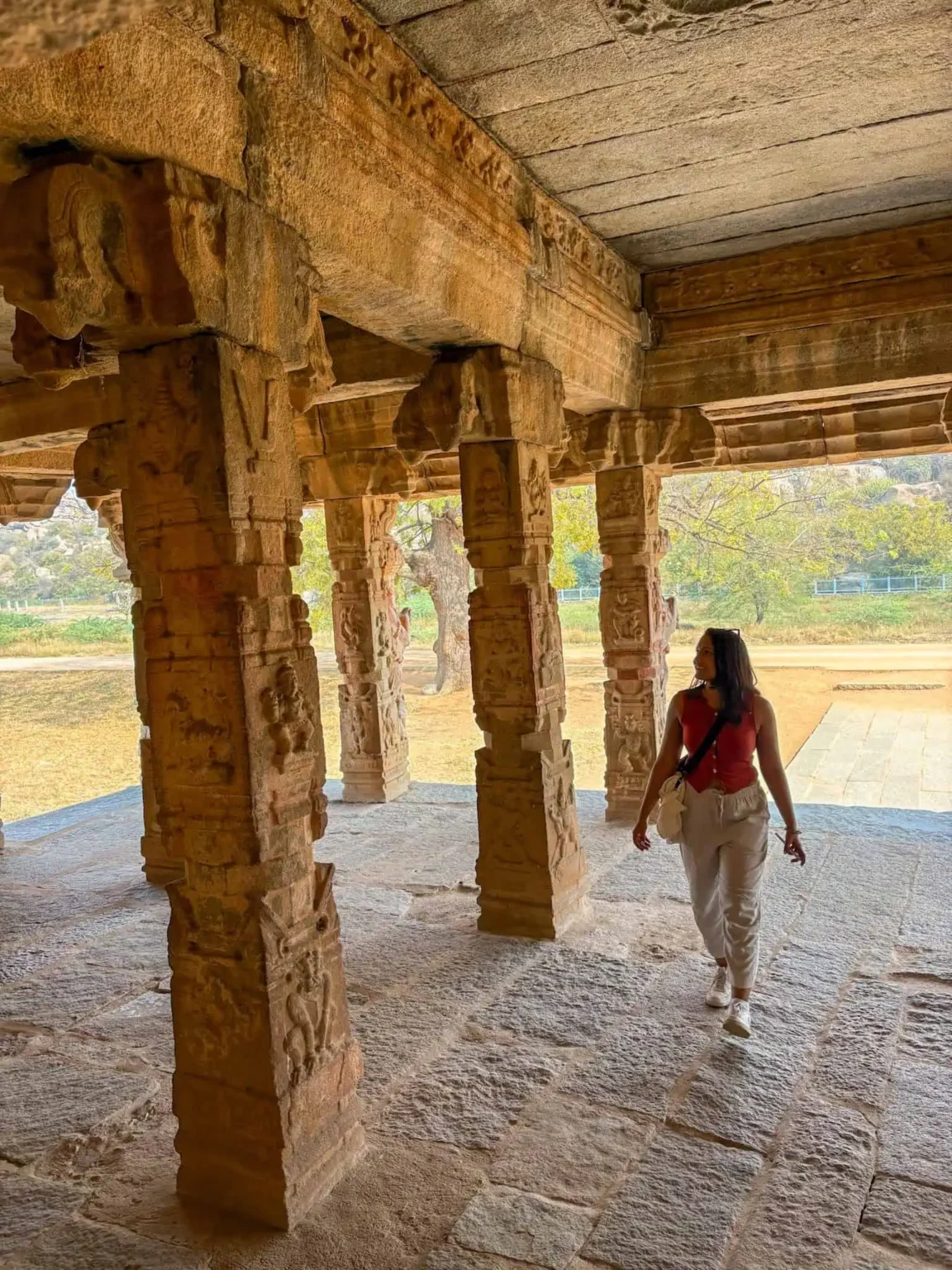
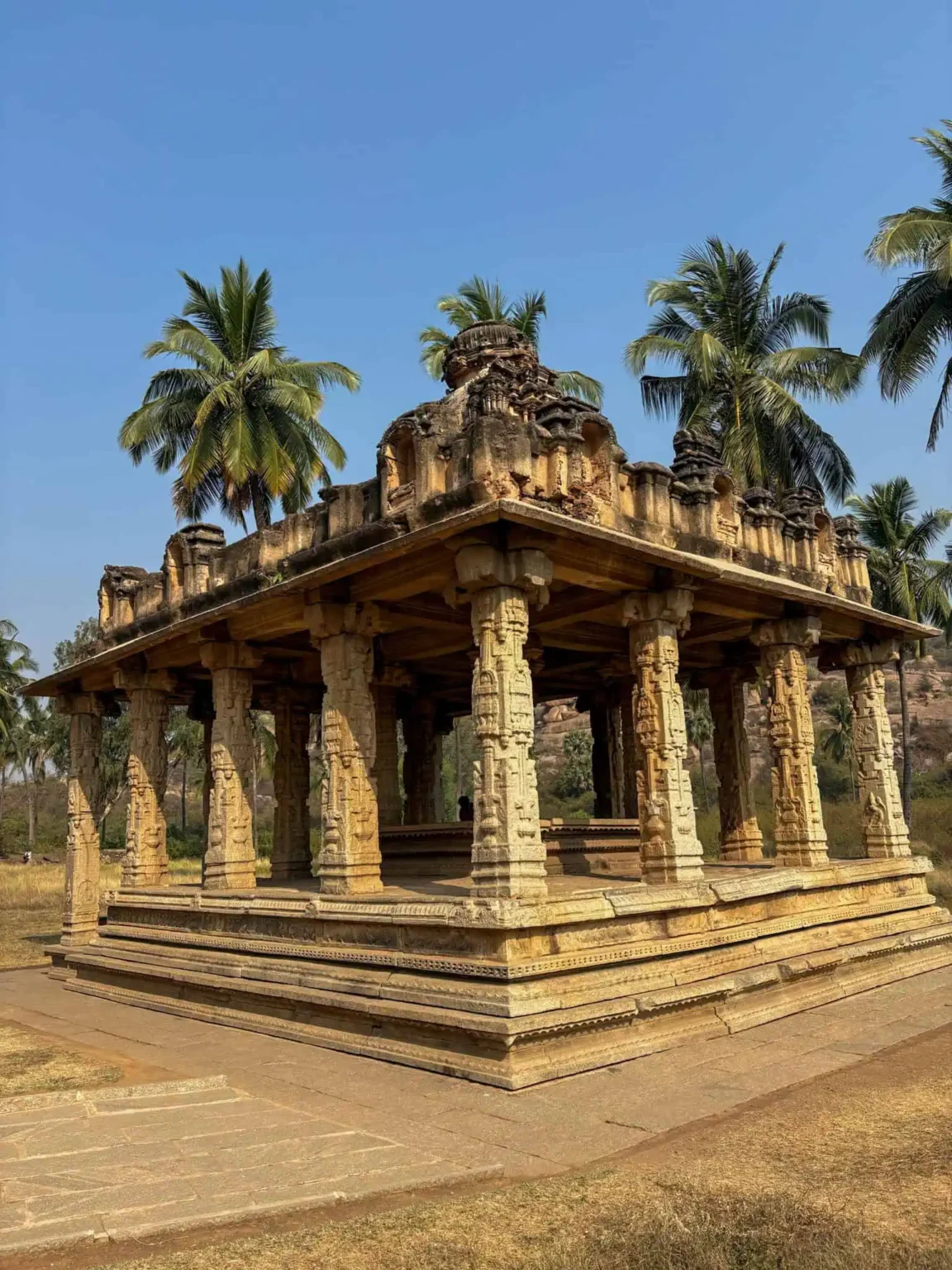
Our first stop was Gejjala Mantapa, a beautifully carved stone pavilion that once marked a ceremonial entrance into the city. Standing here, surrounded by scattered ruins and open land, it is hard to imagine that this was once part of one of the richest and most powerful cities in the world.
From Gejjala Mantapa, we walked along the Old Bazaar Road, following what would have been the main commercial street of Hampi centuries ago. Even though the market stalls are long gone, the layout of the bazaar is still clearly visible. Long rows of stone platforms line the road, giving a real sense of how busy and important this area must once have been.
This walk is a gentle introduction to Hampi and one we really enjoyed. It is flat, relatively quiet early in the morning, and gives you time to take everything in without feeling overwhelmed.
Visiting the Vijaya Vitthala Temple and Stone Chariot
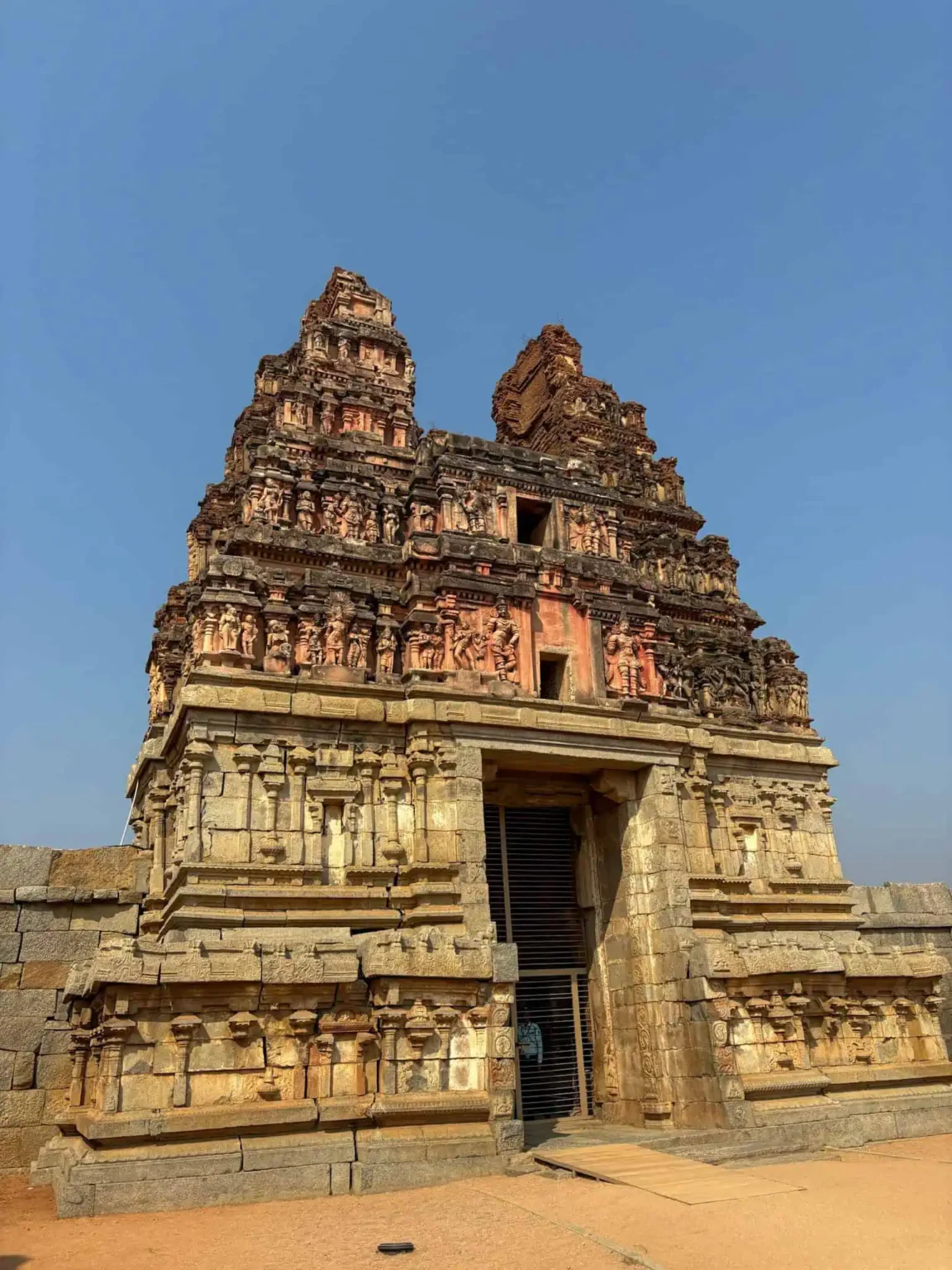
No 2-day Hampi itinerary would be complete without the Vijaya Vitthala Temple, and it fully deserves its reputation. This is one of Hampi’s most iconic and impressive sites.
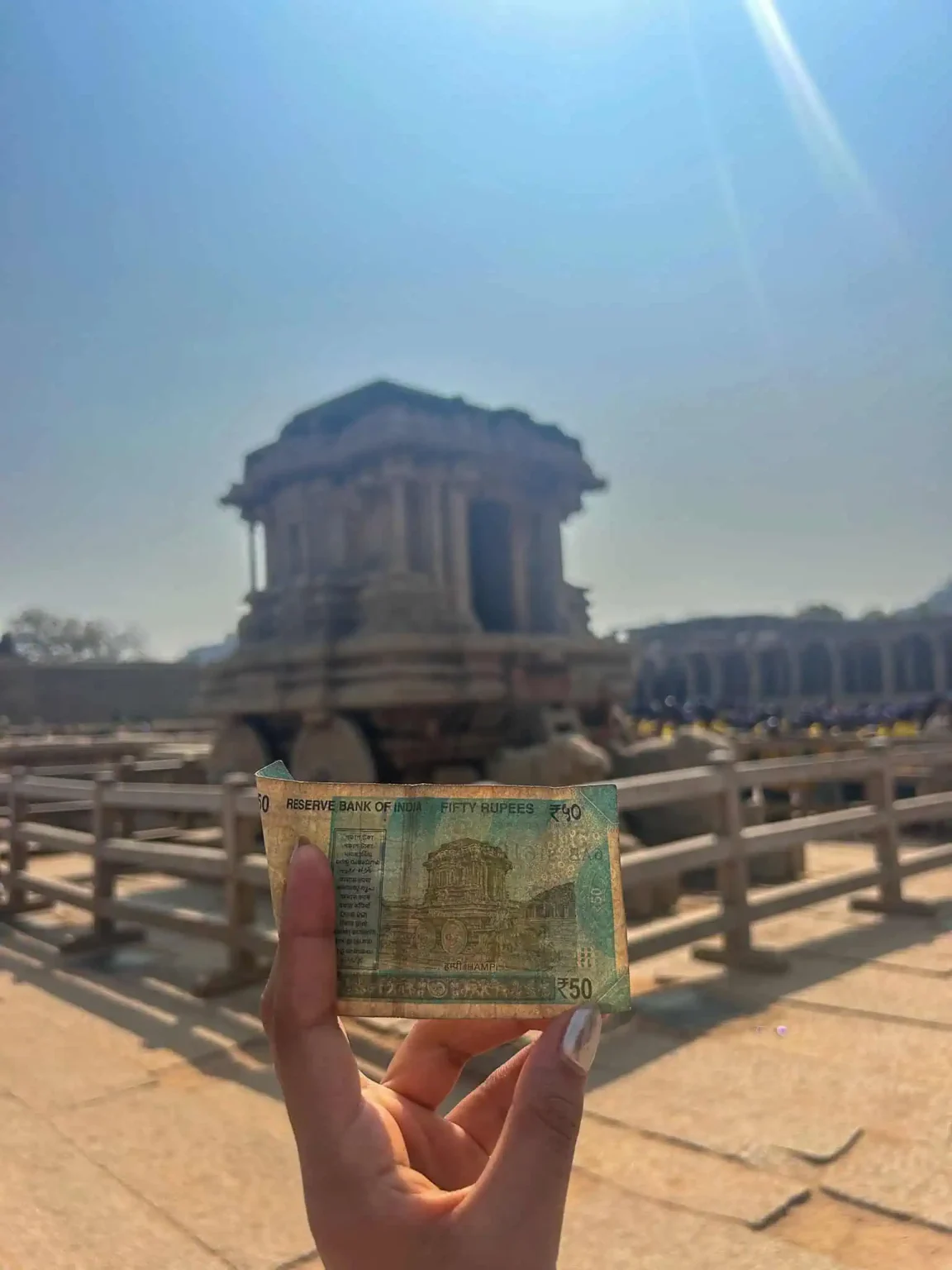
The temple complex is spacious and richly detailed, but the main highlight is the Stone Chariot, famously featured on the Indian 50 Rupee note. While you may have seen it in photos, seeing it in person is far more striking. The scale and craftsmanship are extraordinary, and it quickly becomes clear why this monument is so closely associated with Hampi. Be sure to take plenty of pictures as we did.
Inside the complex, you will also find the musical pillars, one of Hampi’s most fascinating architectural features.
We highly recommend hiring a guide here. For around ₹100 per person, including entry, a guide will explain the history, demonstrate the musical pillars, and help you find the best photo angles. Guides wait just outside the main entrance.
A Stop at the Hampi Archaeological Museum
After the temple, we visited the Hampi Archaeological Museum, which turned out to be more interesting than expected.
The museum provides background on the Vijayanagara Empire, explains how the city functioned, and displays sculptures and artefacts found around the site. It helps connect the dots between the ruins you are seeing and the civilisation that once existed here.
If you enjoy understanding the context behind what you are visiting, this is a worthwhile stop. Though if short on time, this is the one we’d skip from this day of the Hampi itinerary.
Lunch at Hampi Paradise Restaurant
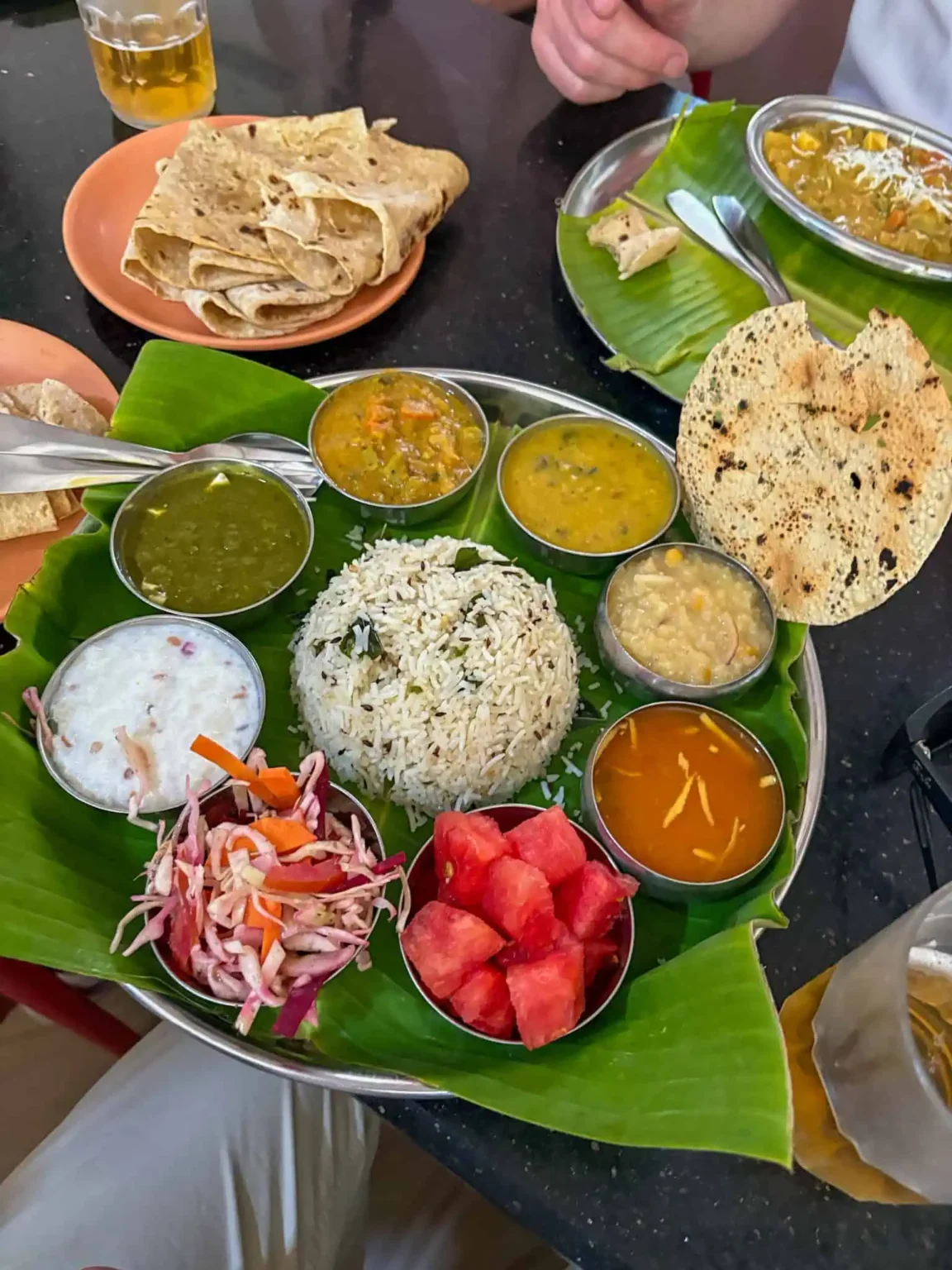
By early afternoon, the heat had started to build, so we stopped for lunch at Hampi Paradise Restaurant, a recommendation from our driver. The food was simple and light, we all had north or south indian Thalis, and it was a good place to sit down, cool off in the air-conditioned section, and recharge before continuing.
Hampi does not have a huge range of restaurants, so knowing a few reliable spots is useful.
Exploring the Queen’s Bath
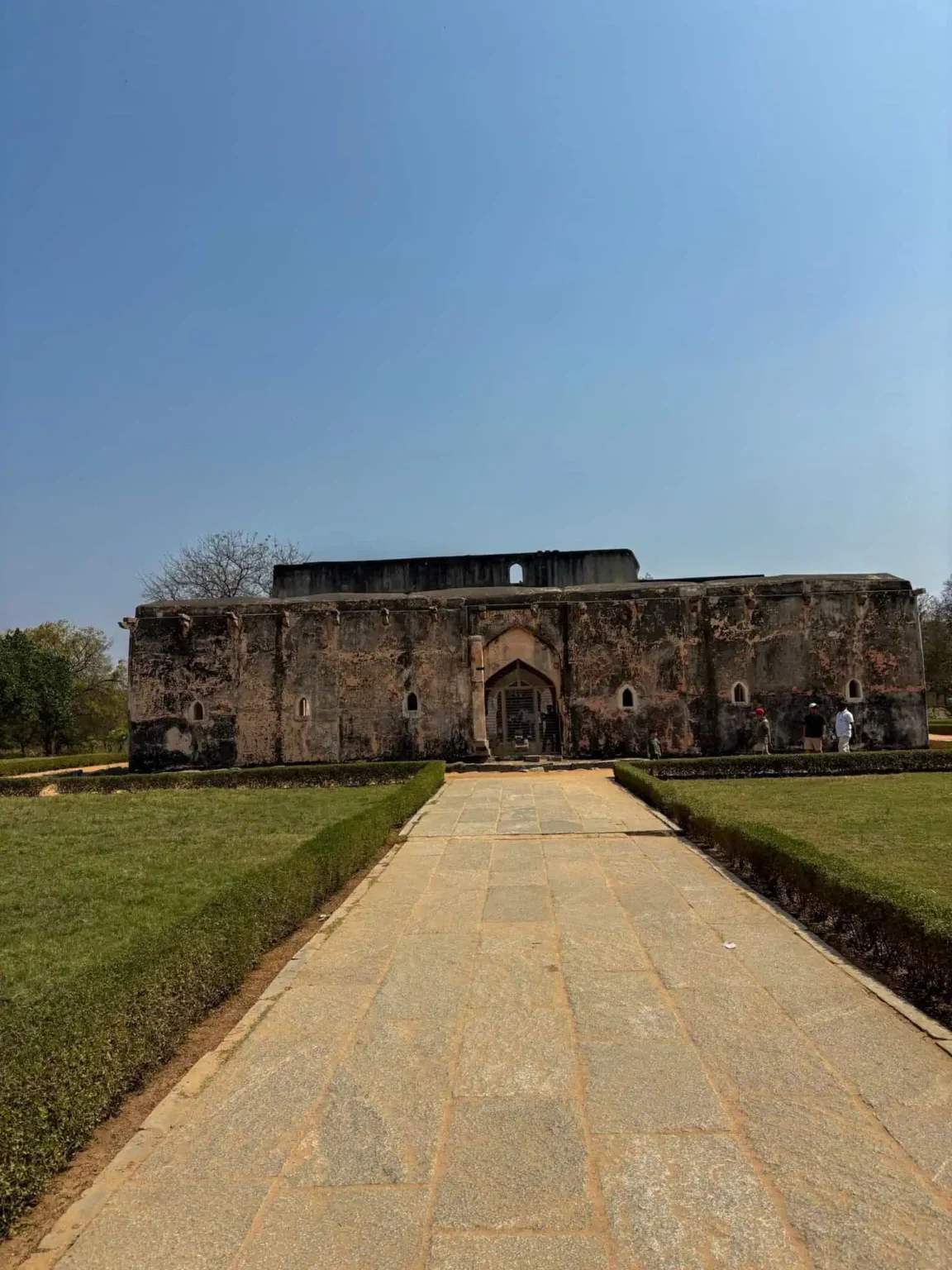
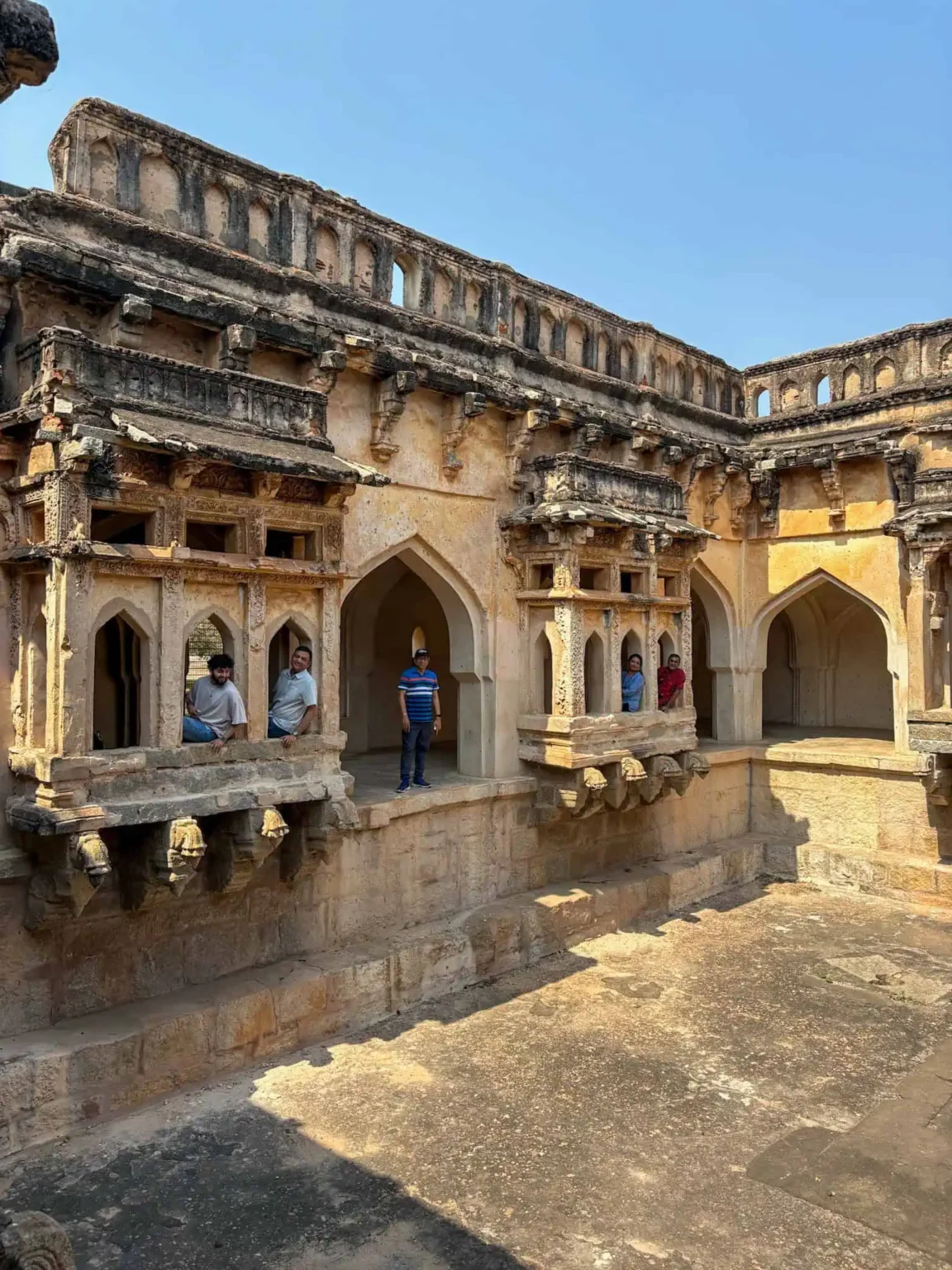
After lunch, we headed to the Queen’s Bath, located within the royal enclosure area. This part of Hampi feels noticeably different from the temples. Instead of towering gopurams and open courtyards, the architecture here is enclosed, symmetrical, and almost elegant.
The large central bathing pool is surrounded by arched corridors and carved details, offering a glimpse into royal life rather than religious rituals. It is not a long visit, but it provides a nice change of pace and adds variety to the day.
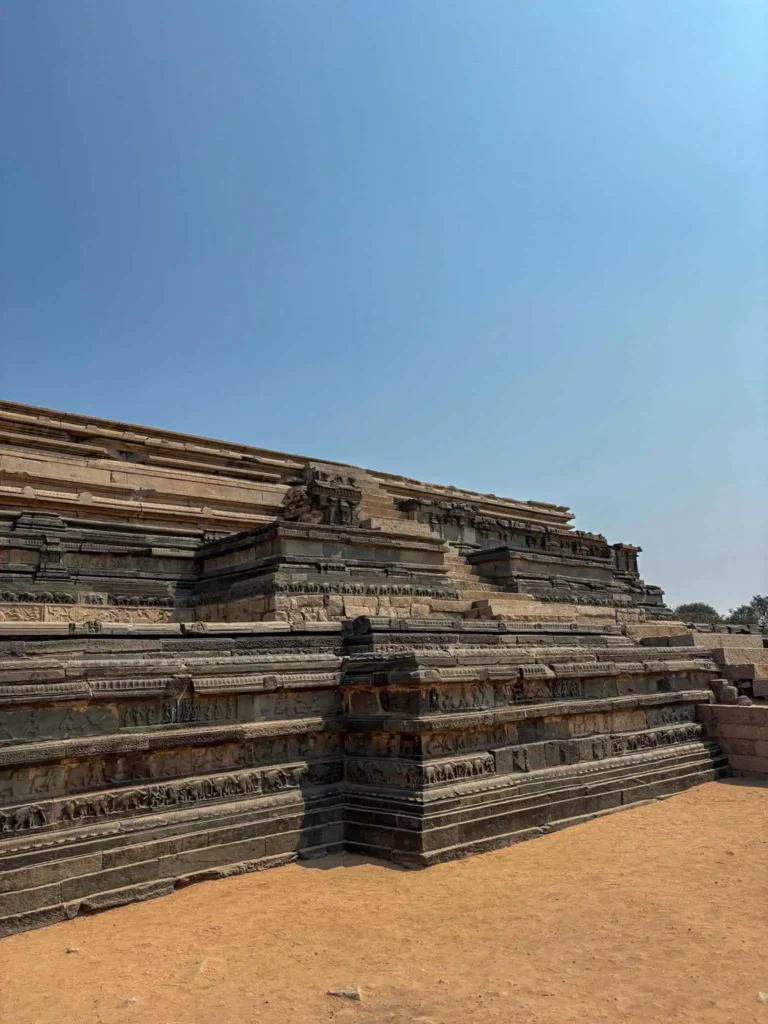
Pushkarani Kola and Mahanavami Dibba
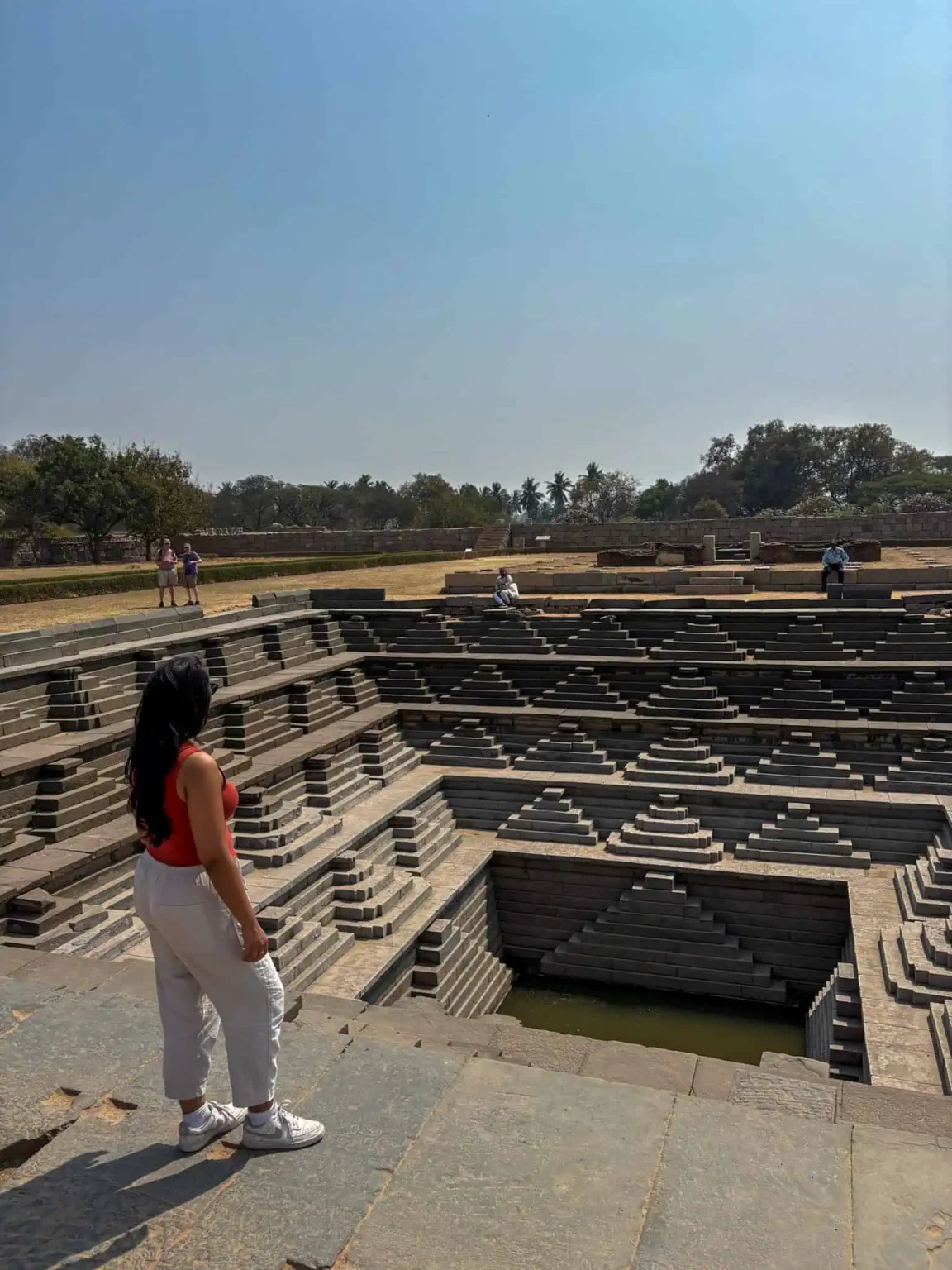
Nearby, we visited Pushkarani Kola, a stepwell with surprisingly advanced early plumbing still visible today, and Mahanavami Dibba, a large raised platform once used for royal ceremonies and celebrations.
Climbing the Dibba gives you an elevated view over the surrounding ruins and open landscape. From up here, you really begin to understand the scale of Hampi. Temples, walls, and pathways stretch out in every direction, far beyond what you see at ground level.
This area feels noticeably quieter than the main temples and is a great place to pause, take photos, and soak in the atmosphere without the crowds.
Lotus Mahal and Elephant Stables
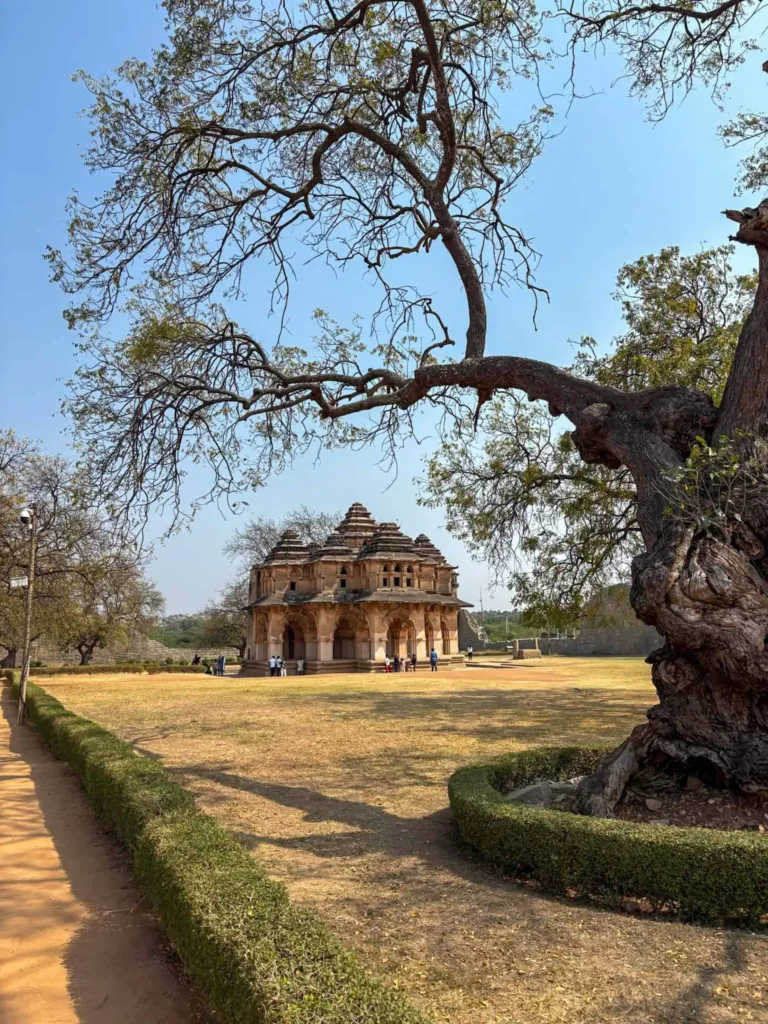
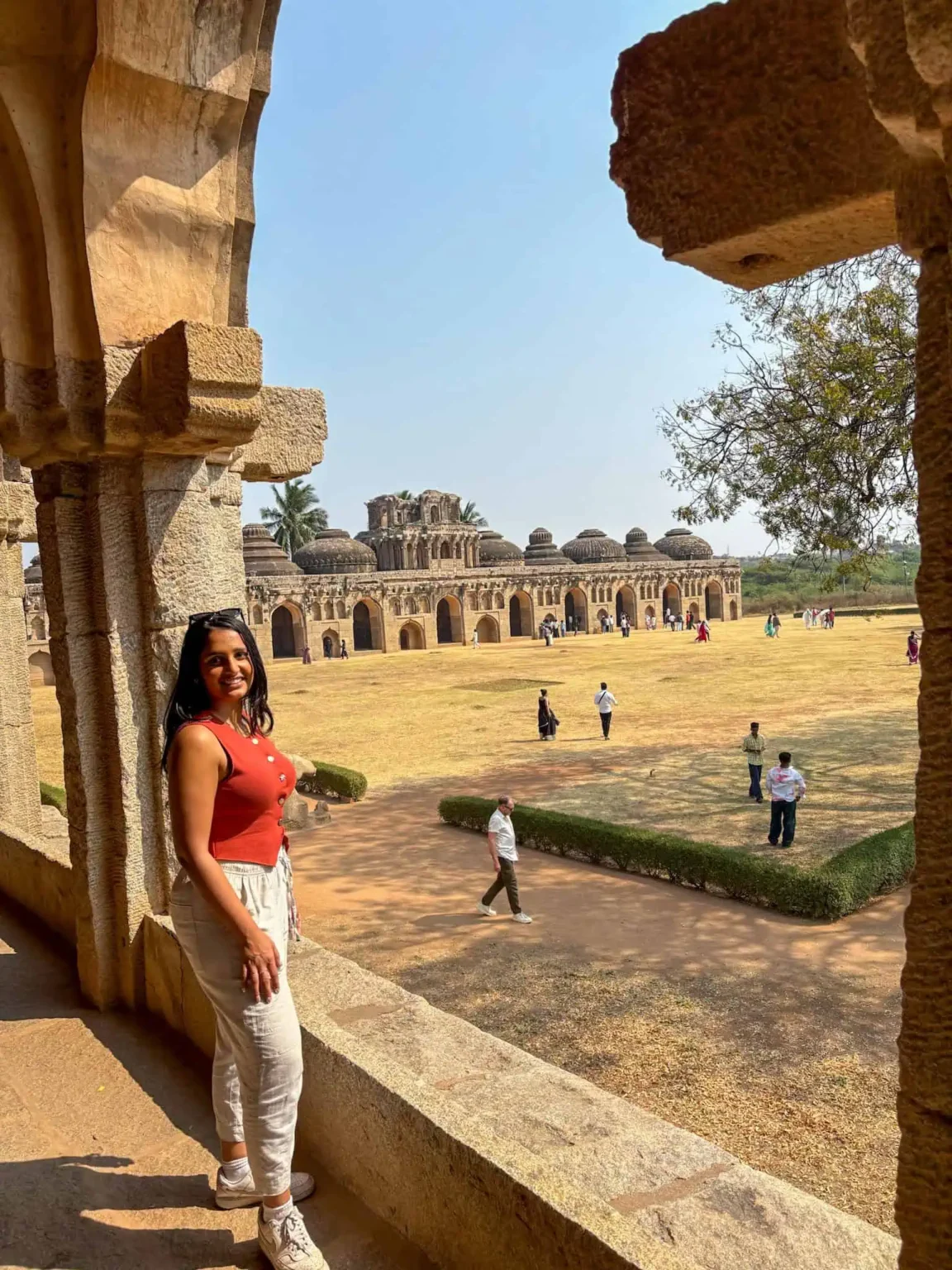
These were the last of the major Vijayanagara-era monuments we visited that day. The Lotus Mahal and Elephant Stables sit close together, making them easy to combine into one relaxed stop.
Architecturally, they feel very different, which is what makes this area so interesting. The Lotus Mahal is delicate and almost airy, with elegant arches and a graceful design that blends Hindu and Islamic influences. In contrast, the Elephant Stables are large, solid, and perfectly symmetrical, built to house the royal elephants of the empire.
This part of Hampi is one of the most photogenic, and walking between the two gives a real sense of the city’s former wealth and importance.
Slowing Down at Hampi Village and Ganesh Old Chillout
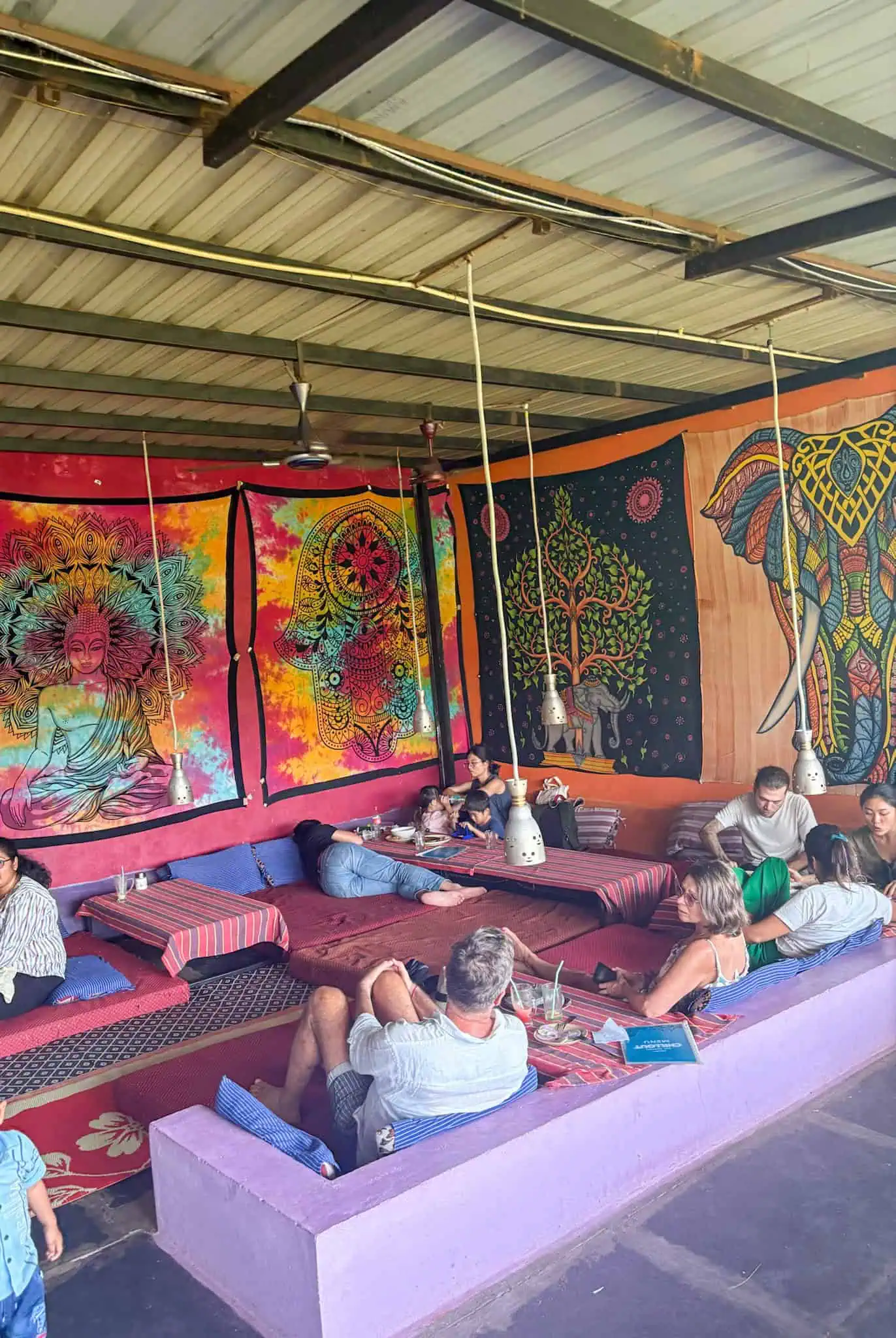
Later in the afternoon, we returned toward Hampi village and spent some time at Ganesh Old Chillout. It is a relaxed spot near the river, surrounded by banana plants, that has a nice ‘hippie’ style vibe.
It’s a great place to slow down after a full day of sightseeing. The mango Lassis were delicious!
Hampi is not just about monuments. Sitting, watching daily life, and letting the place sink in is part of the experience people visit for.
Virupaksha Temple and Tungabhadra River
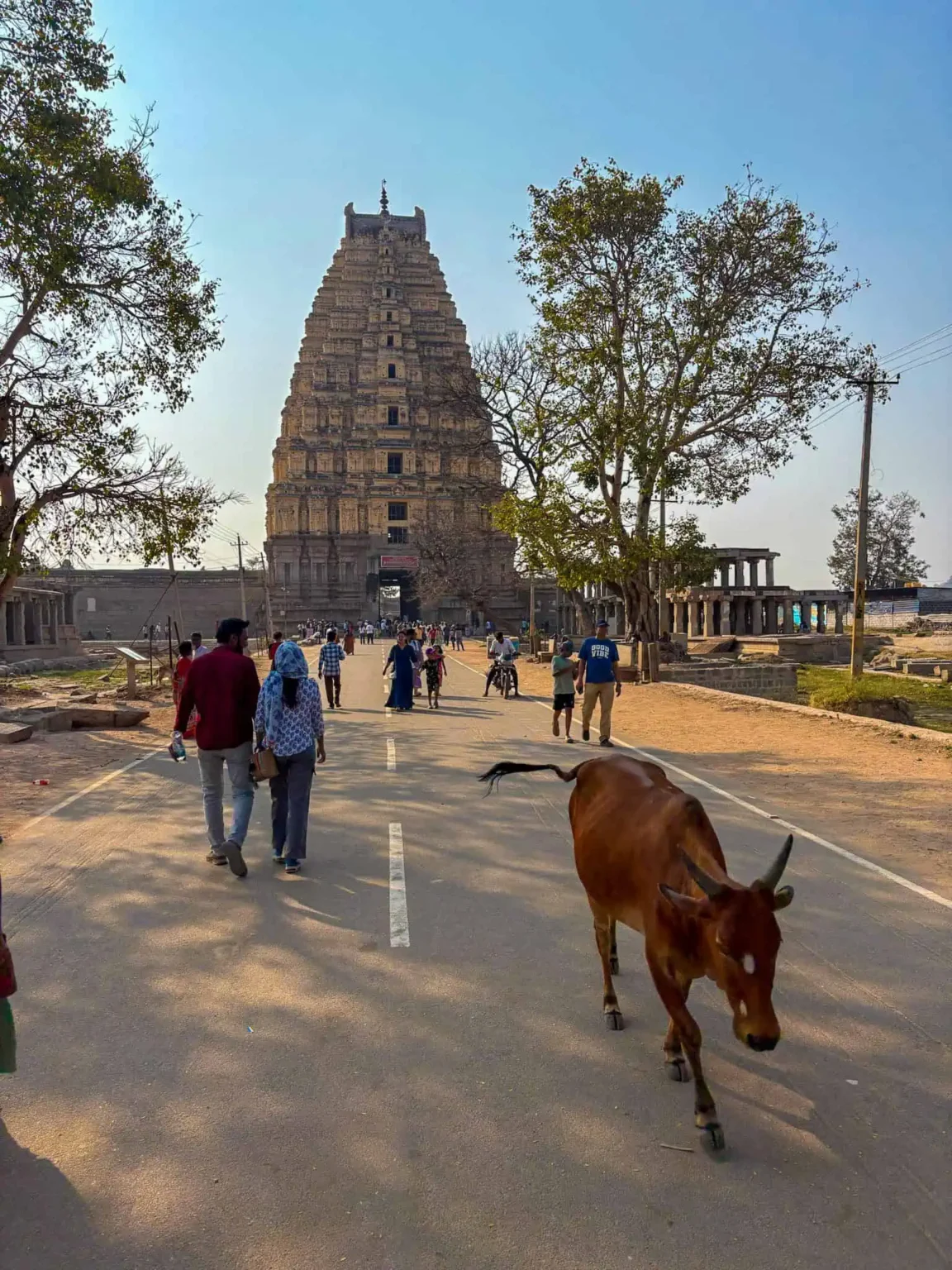
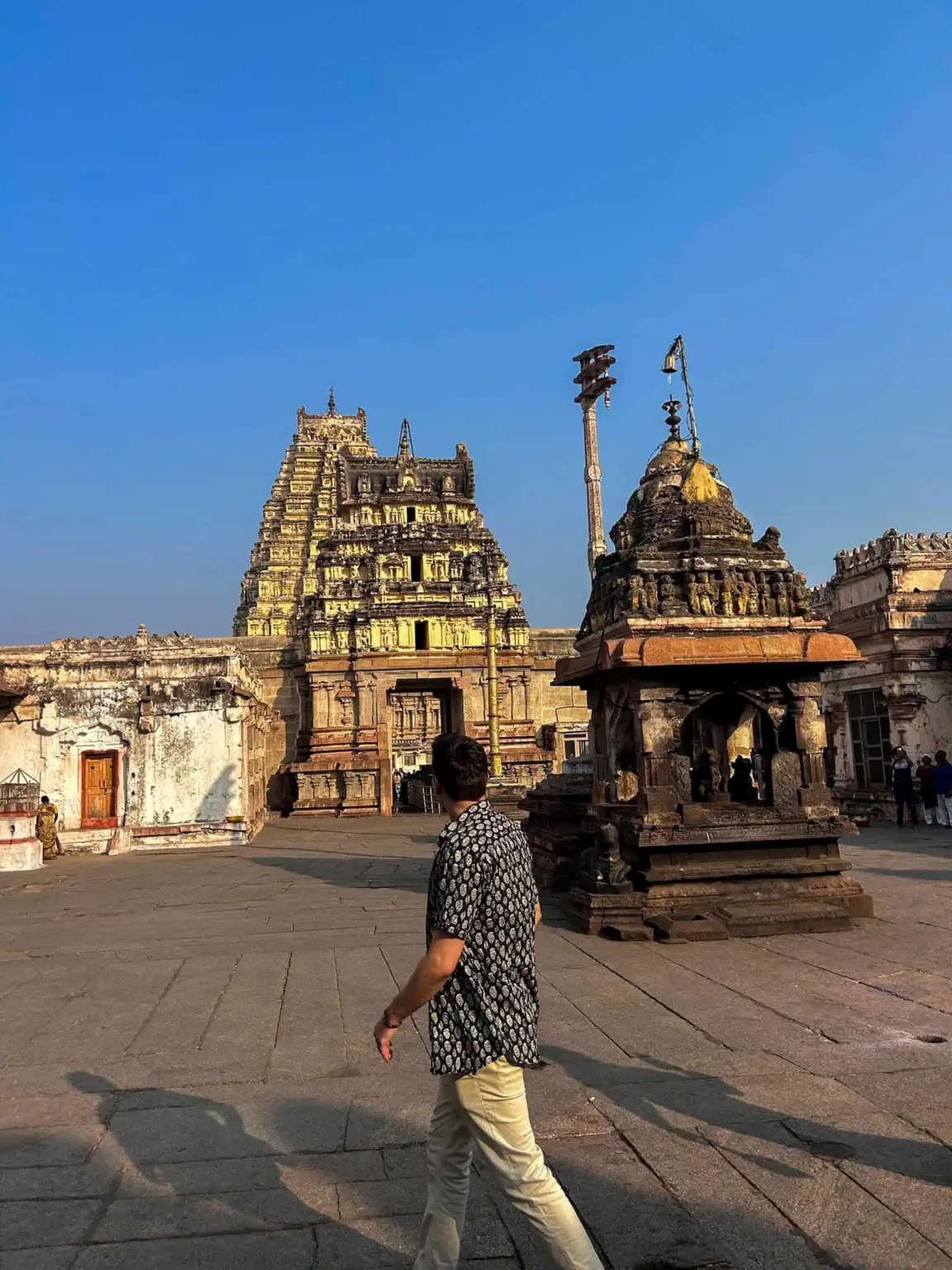
We walked the short distance from Ganesh Old Chillout to the entrance of what became our favourite place in Hampi, Virupaksha Temple.
Dating back to the 7th century, this temple completely enthralled us. After a full day exploring ruins and monuments from a fallen empire, places that have not been in use for centuries, stepping into a temple from the same era that is still actively used by locals felt genuinely magical.
The architecture alone is stunning. The temple is vast and beautiful from almost every angle. But it is worth putting the camera down for a moment and taking in the atmosphere. Even as non-spiritual people, this place really affected us. Devotees ringing bells after prayer, groups of women chanting Hindu mantras, and the simple awareness that people have been worshipping here for centuries all add to the experience.
Behind the temple, you can walk down towards the Tungabhadra River. Here, devotees bathe in what they believe is holy water, while locals wash clothes along the riverbank. It is a quiet, everyday scene, and one of those moments that feels uniquely Indian and deeply memorable.
Visiting the Kadalekalu Ganesha Statue
Before sunset, we made a short stop at Kadalekalu Ganesha, a massive monolithic statue of Lord Ganesha, an elephant-headed Hindu God, set inside a small stone pavilion. The scale of the statue is impressive, and it is worth visiting even if you are not particularly interested in religious sites.
Sunset from Hemakunta Hill
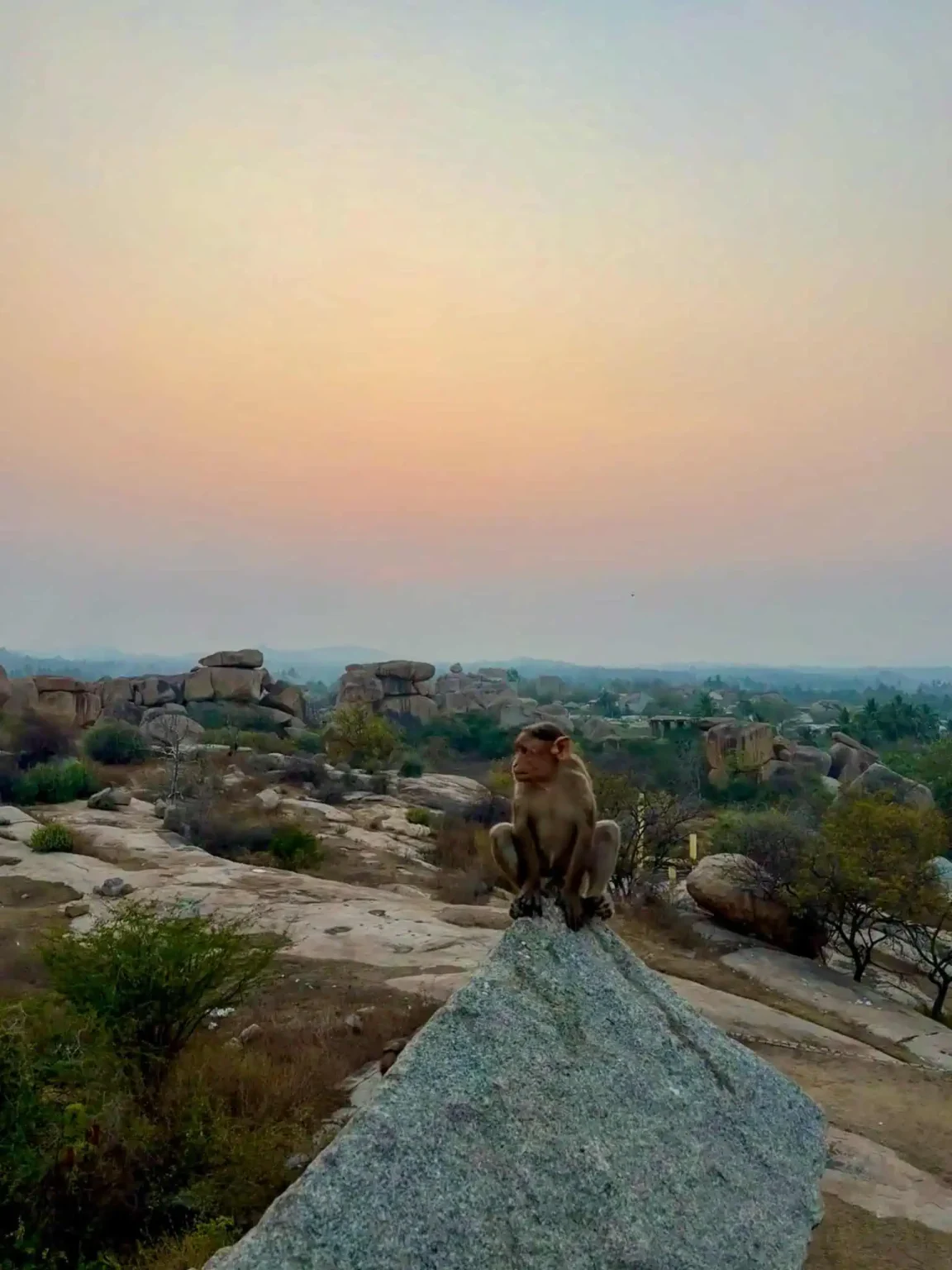
One of the highlights of the entire trip was watching the sunset from Hemakunta Hill. Approaching it from the Kadalekalu Ganesha side means you avoid climbing up from the main temple complex, which makes it an easier option at the end of the day.
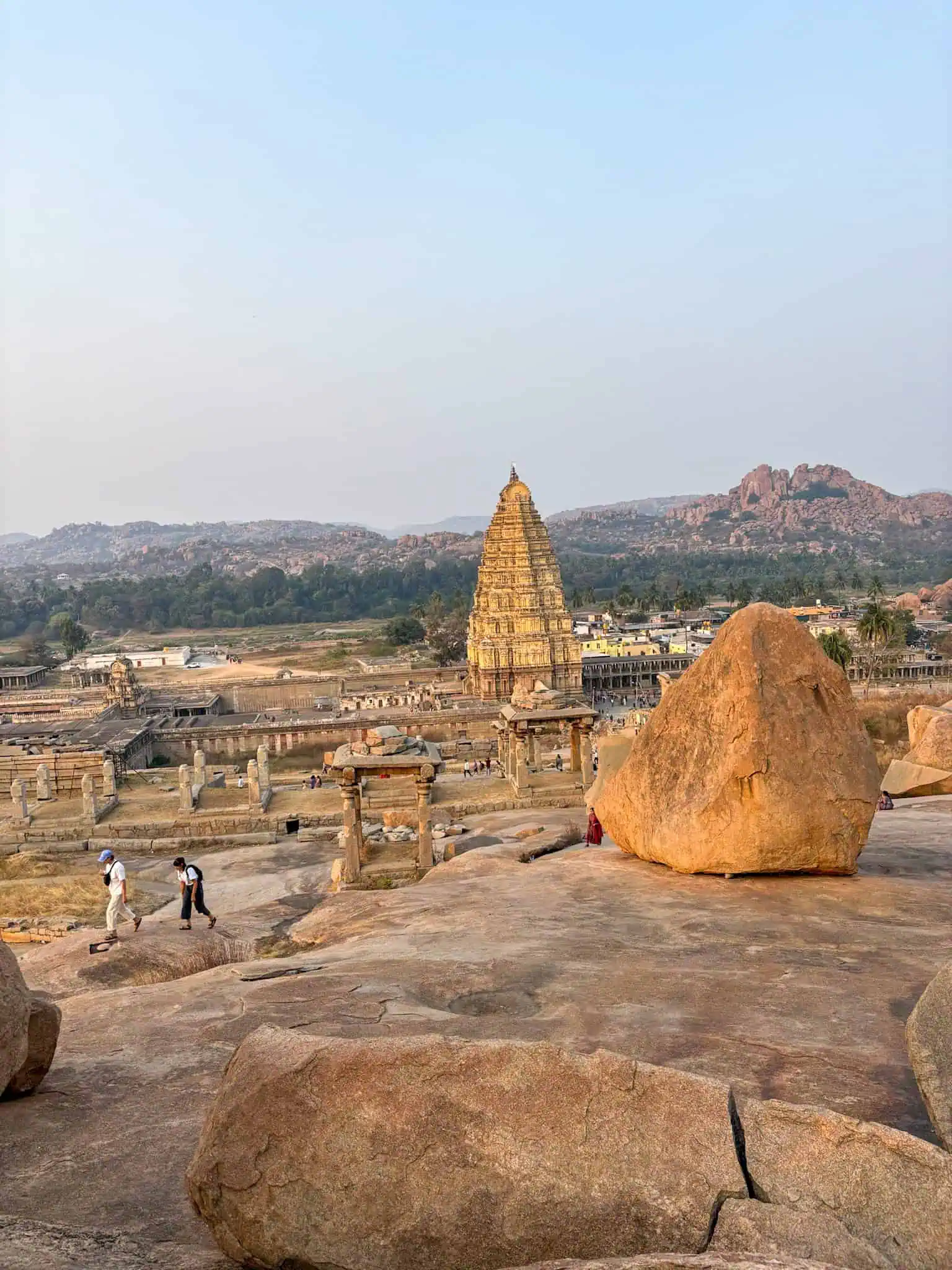
From the hilltop, you can see Virupaksha Temple, the Tungabhadra River, and the surrounding ruins bathed in soft evening light. As the sun sinks lower, the landscape slowly changes colour, and the atmosphere becomes calm and reflective.
This area is also home to a lot of monkeys, who begin appearing from across the rocky landscape as sunset approaches. Watching them move across the boulders almost feels like a scene from Planet of the Apes, and adds to the sense that Hampi is still very much alive.
It is a peaceful and memorable way to end your first day exploring Hampi.

Dinner at Mango Tree Restaurant
After sunset, we headed to Mango Tree Restaurant for dinner, not to be confused with Mango Tree Homestay, where we were staying.
This is another bohemian-style spot, but the food here really stands out. The dosas, thalis and curries, all served traditionally on a banana leaf, were excellent and the perfect way to finish the day before heading back to our accommodation.
Day 2 in Hampi: Sacred Temples, River Crossings and Rural Landscapes
The second day in Hampi felt very different from the first. It was quieter, greener, and more focused on spiritual sites and rural life, especially across the river in Anegundi, formerly known as Hampi’s Hippie Island.
Early Morning at Malyavanta Raghunatha Temple
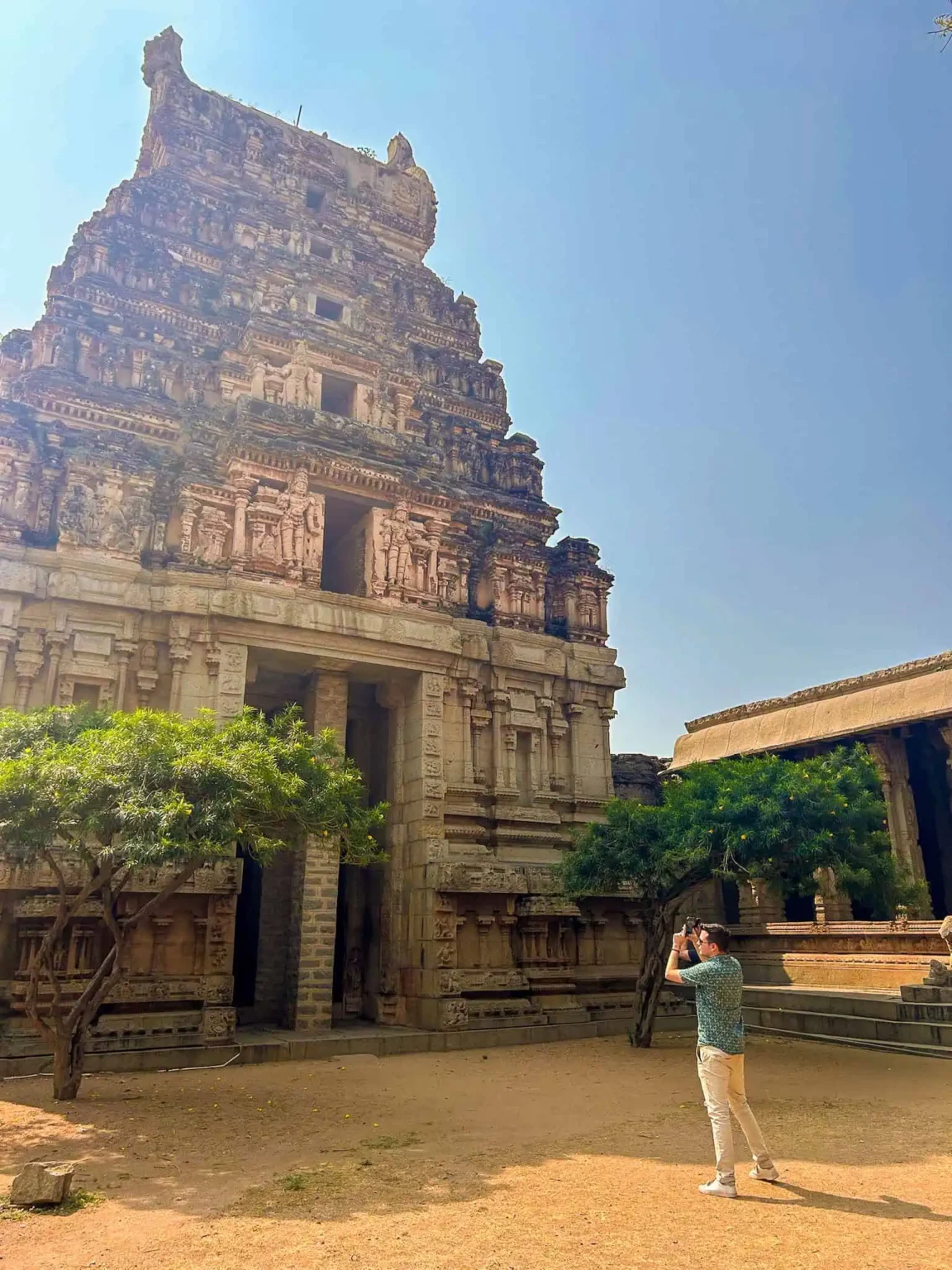
We started early with a visit to Shri Malyavanta Raghunatha Temple, and it turned out to be one of the best temples in Hampi.
The temple is deeply important to Hindus and is believed to be the place where Lord Ram, one of the main Hindu gods, sheltered during the rainy season while searching for his wife Sita, as told in the epic Ramayana.
Outside the temple, there are many monkeys that live in the surrounding rocks. Despite their reputation elsewhere, they were surprisingly calm and friendly here. Our auto driver even bought some bananas for them, which quickly became a source of entertainment for everyone involved.
Although this temple sees fewer visitors than places like Virupaksha, it is no less beautiful. The carvings around the entrances and main structures are intricate, and in the early morning light, the stone almost seems to glow against the surrounding landscape.
What truly sets this temple apart is the continuous chanting. Holy men recite verses from the Ramayana twenty-four hours a day, seven days a week. They even invited us to join in by playing simple instruments, which felt like a rare and very special experience.
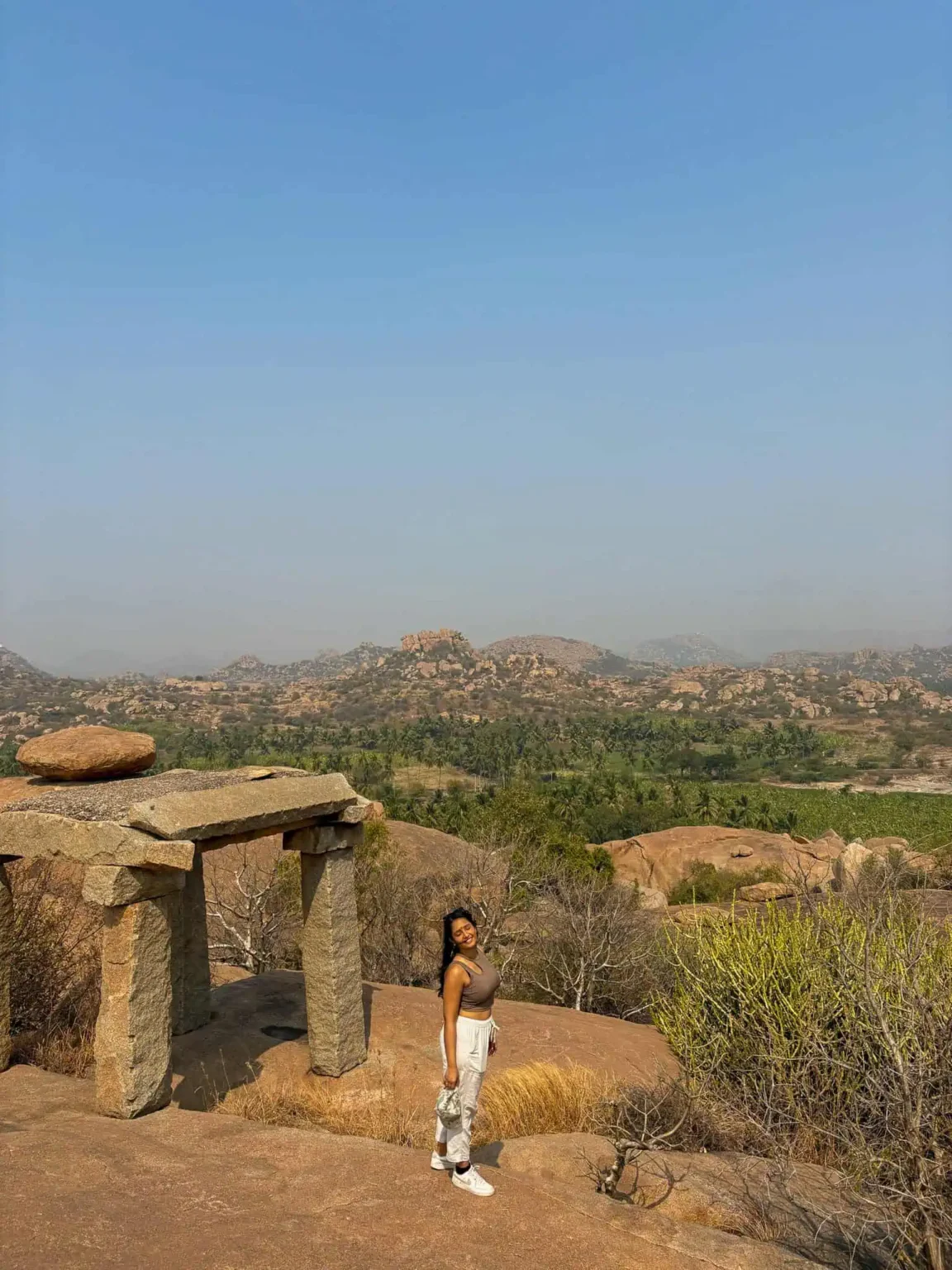
If you go out the rear doorway, there are more smaller temples to the Hindu god, Shiva, and an utterly incredible view over the Hampi landscape. Probably the best view of the boulders in all of Hampi.
Exploring Anegundi on the other side of the river
Next, we crossed the Tungabhadra River by boat to reach Anegundi.
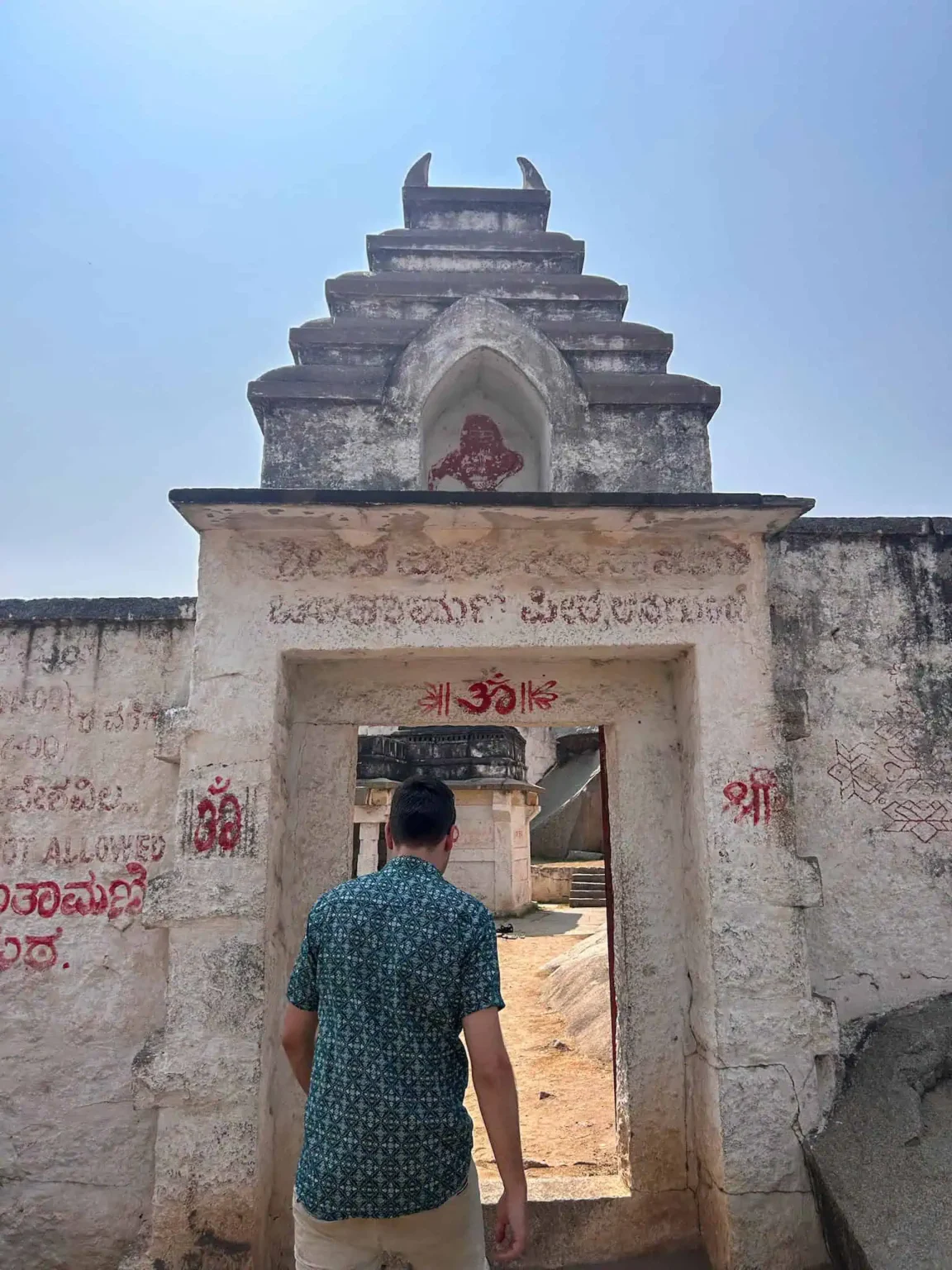
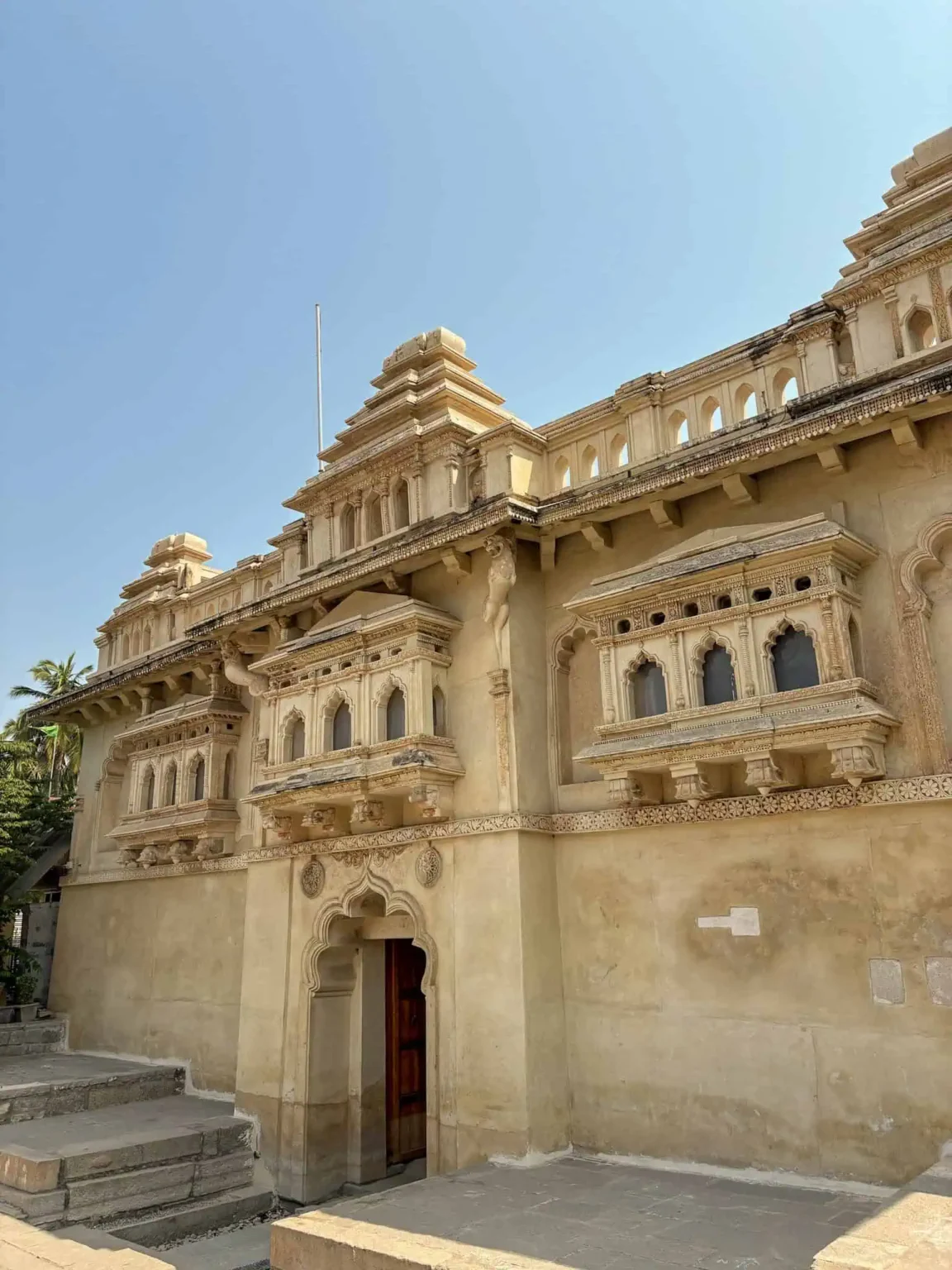
In Anegundi, we visited Gagana Mahal Palace, a modest royal structure with historical significance, and Chintamani Temple, which feels very much part of local life.
From here, you get beautiful views of the river and surrounding hills, a reminder that Hampi’s story isn’t confined to one side of the Tungabhadra. These sites add a layer of depth to any 2-day Hampi itinerary, showing a side of the region that most travellers miss.
These sites are not grand in the same way as Hampi’s main monuments, but they add depth to the experience and show a different side of the region.
Lunch at Tutti Cafe
By midday, it was time to refuel at Tutti Cafe, a popular spot for travellers exploring Anegundi. The atmosphere is relaxed, with shaded seating and friendly staff, perfect for a longer break before continuing your sightseeing.
We tried paneer pakora, onion pakora, chai, and refreshing lassis. The food was simple but satisfying, and it gave us a chance to recharge for the afternoon ahead. This is the kind of stop that makes a Hampi itinerary for 2 days feel manageable rather than rushed.
Visiting Pampa Sarovara
After lunch, we made our way to Pampa Sarovara, a sacred lake set amidst hills and lush greenery. This tranquil spot is tied to Hindu mythology, and it felt like a perfect place to pause and take in the slower pace of life here.
We were lucky enough to spot crocodiles from a safe distance, a thrilling reminder that Hampi and Anegundi are as wild as they are historic. Despite the wildlife, the atmosphere is calm and contemplative.
Returning to Hampi and Coracle Ride on the River
We crossed back over the river to the Hampi side and visited the Sri Yantrodharaka Hanuman Temple, which is set among rocks near the river.
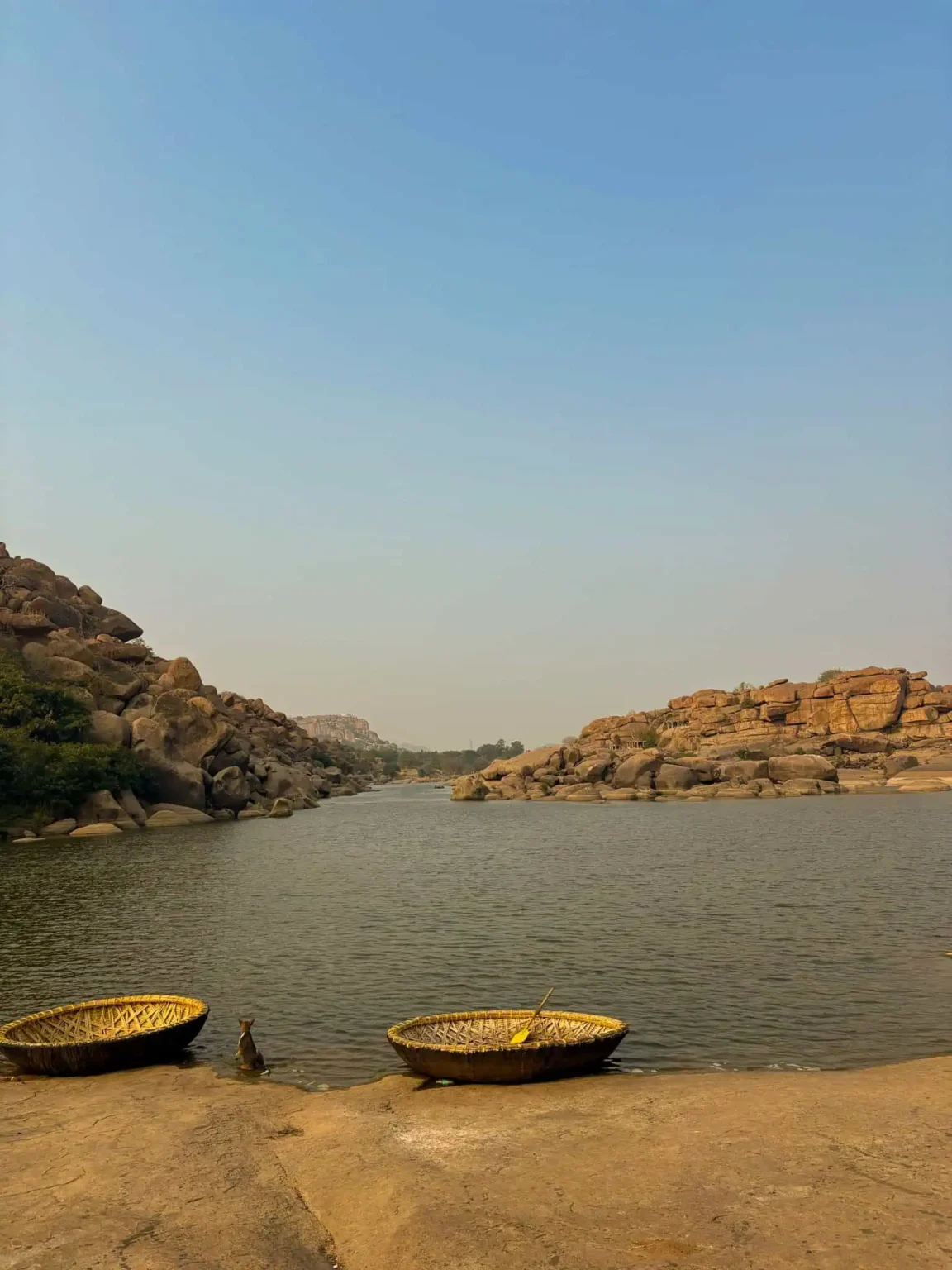
Just a short walk from the temple, we hopped onto a coracle, a traditional circular boat used on the Tungabhadra. The ride is brief but surprisingly peaceful. Floating on the water gives a fresh perspective on Hampi’s riverside landscapes, with the rocky terrain and distant ruins looking entirely different from the ground level. Watching villagers and temple-goers along the banks, it’s easy to see how the river remains central to daily life here.
Seeing Lakshmi, the Temple Elephant
In the early evening, we timed our visit to see Lakshmi, the temple elephant, during her daily walk. Watching her move through the area is a unique experience and one that many visitors try to catch.
It’s better to see her this way, or when she’s bathing in the river, as she seems happier than when she is within the temple in her enclosure.
Ending the Trip with Another Sunset Over Hampi
To finish the trip, we watched the sunset once again from a hill overlooking Hampi. Ending both days with sunset views felt like the right way to experience the place.
After two days in Hampi, the landscape felt familiar but still fascinating. The ruins, the river, and the hills all seemed to come together in that final moment.
Practical Tips for Visiting Hampi
Hampi is rewarding, but it helps to be prepared.
The best time to visit Hampi is between October and March, when temperatures are more manageable. Starting early each day makes a big difference, especially if you want to avoid the midday heat.
Wear comfortable walking shoes, carry plenty of water, and be mindful of monkeys around temples. Distances can be deceptive, so planning your days realistically will make your trip far more enjoyable.
Is Two Days in Hampi Enough?
Two days in Hampi is enough to see the highlights without feeling rushed, especially if you plan your route well and accept that you cannot see everything.
Hampi is not a place you conquer. It is a place you experience slowly. Even in two days, it leaves a strong impression, and it is the kind of destination that makes you want to return.
If you enjoy history, landscapes, and places that still feel deeply connected to their past, Hampi is absolutely worth the effort.
FAQs for your Hampi Trip
Can you see Hampi in 2 days?
Yes! Two days are enough to visit the main temples, royal ruins, and scenic viewpoints without feeling rushed. This 2-day Hampi itinerary focuses on the highlights while allowing time to soak in the landscape and local culture.
What are the best temples to visit in Hampi?
Some of the most important and visually stunning temples include Virupaksha Temple, Vijaya Vitthala Temple, and Shri Malyavanta Raghunatha Temple. Each offers a unique glimpse into Hampi’s spiritual and architectural heritage.
Where is the best area to stay in Hampi?
For convenience and comfort, staying in Kamalapur or Hosapet is ideal, especially for a short visit. If you prefer a quieter, greener area, consider Anegundi (Hippie Island), though crossing the river after sunset can be tricky.
How do you get to Hampi?
Hampi can be reached by train, bus, or private car. The Hampi Express overnight train from Bangalore is a popular option, saving a night of accommodation and arriving early to start sightseeing. Buses and taxis from nearby cities like Hubli and Goa are also available.
What is the best time of year to visit Hampi?
The best months are October through March, when temperatures are cooler and more comfortable for exploring. Starting early in the day helps avoid the intense midday heat, especially when walking between ruins.
Is Hampi safe for solo travellers and women?
Yes, in general, Hampi is safe for women and solo travellers, though it is a relatively deprived area in India, so you need to keep your wits about you and be vigilant (We women are used to this while travelling).
You may have seen recent news regarding a horrible incident with tourists in the Hampi area. You do need to stay mindful of your surroundings. We advise not to stay anywhere outside of the main tourist areas at night.
For more advice on how to stay safe in India, see our in-depth post with plenty of tips to help your travels.
What should I wear in Hampi?
Light, breathable clothing is recommended, along with comfortable walking shoes. Since you’ll visit temples, modest attire that covers shoulders and knees is appreciated.
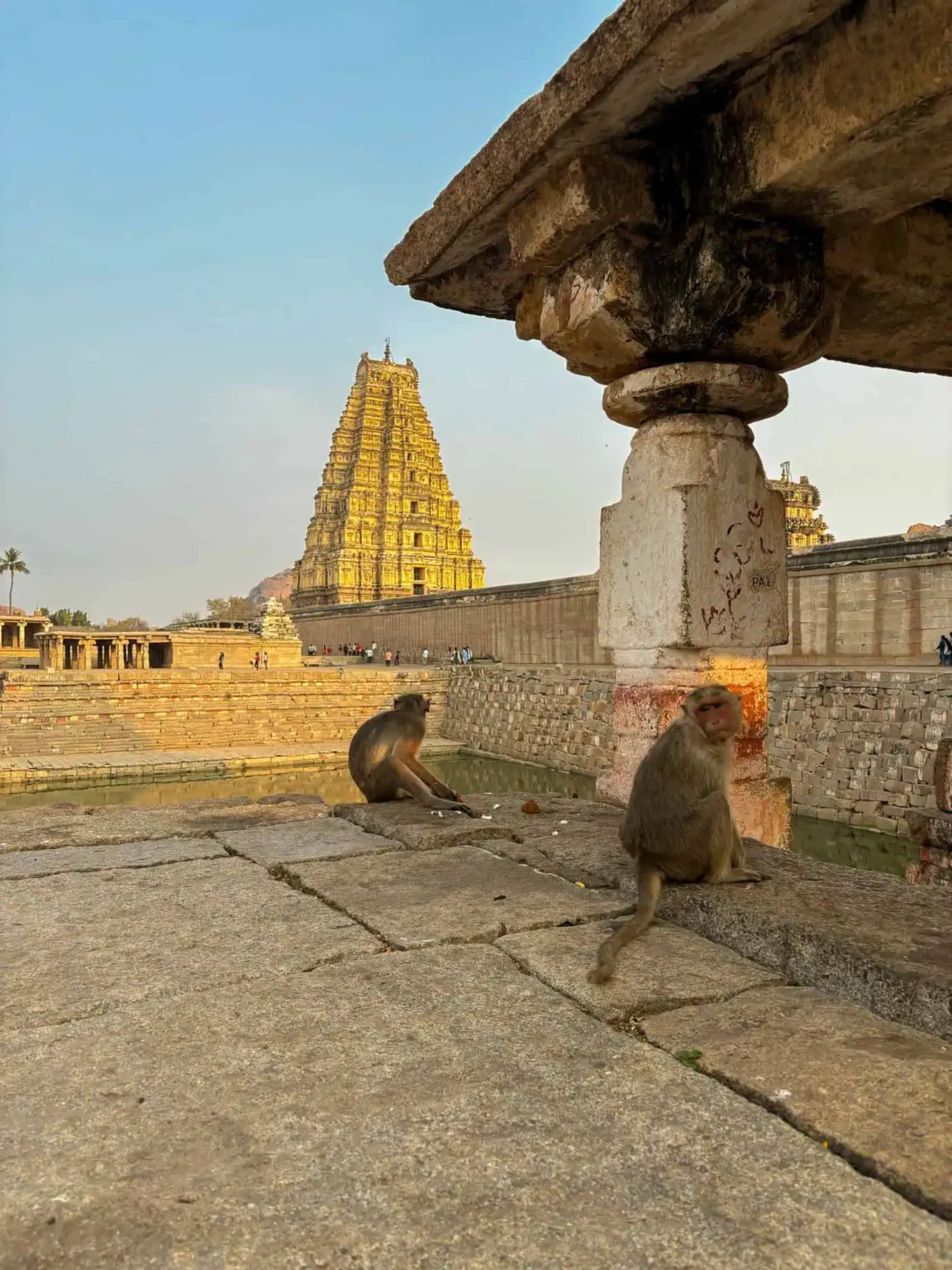
We hope you found our 2-day Hampi itinerary useful!
Have you visited Hampi or would you like to?
Feel free to ask us any questions you may have, or give your own advice in the comments below.